Stretched Bar Display in Urban Transit: A Complete Technical Solution for Passenger Information Systems
Application Scenario: On-Board & Platform Passenger Information Systems (PIS) for Metro and Bus Rapid Transit Networks
The Challenge: Why Standard Displays Fail in Transit Environments
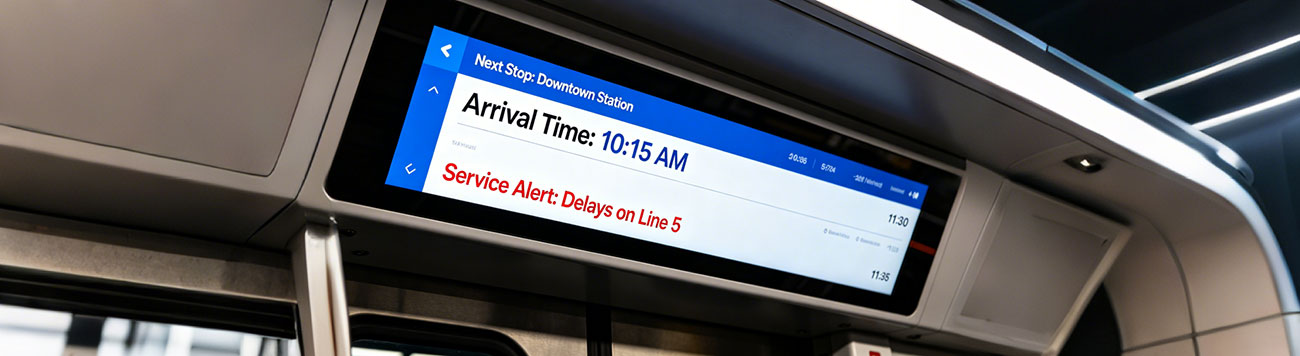
Transit operators upgrading their Passenger Information Systems consistently run into the same wall: the physical geometry of a vehicle cabin or platform edge simply does not accommodate conventional 16:9 screens. A metro car ceiling is roughly 200–250 mm deep from the grab-rail fascia to the overhead panel. A bus header panel above the windshield offers even less vertical clearance. Installing a standard 1080p monitor in either location forces one of three compromises — truncate the content, letterbox it into a thin band that passengers ignore, or cascade multiple small screens across the header, multiplying cabling, media players, and points of failure.
After evaluating hardware from a dozen suppliers across three continents, the engineering conclusion is consistent: a purpose-built stretched bar LCD with a native ultra-wide aspect ratio is the only display technology that resolves the dimensional constraint without sacrificing legibility, durability, or content richness.
Display Specification: What "Stretched Bar" Actually Means for Transit
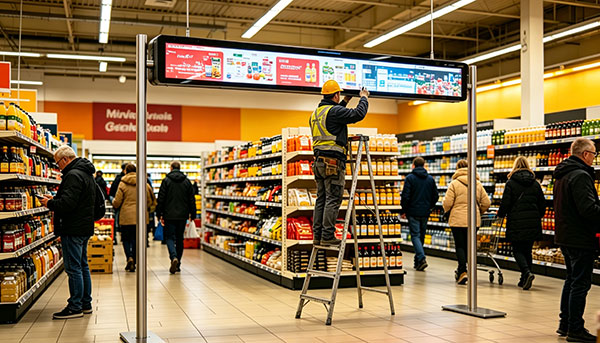
A stretched bar LCD (also referred to as a bar-type display or strip display) is manufactured with a native panel aspect ratio typically between 32:9 and 16:4.5, as opposed to the 16:9 standard. Common transit-grade sizes include:
| Panel Size | Native Resolution | Aspect Ratio | Typical Transit Use |
|---|---|---|---|
| 28" | 1920 × 360 | 16:3 | Bus next-stop display, overhead header |
| 37.5" | 2560 × 720 | 32:9 | Metro cabin side panel |
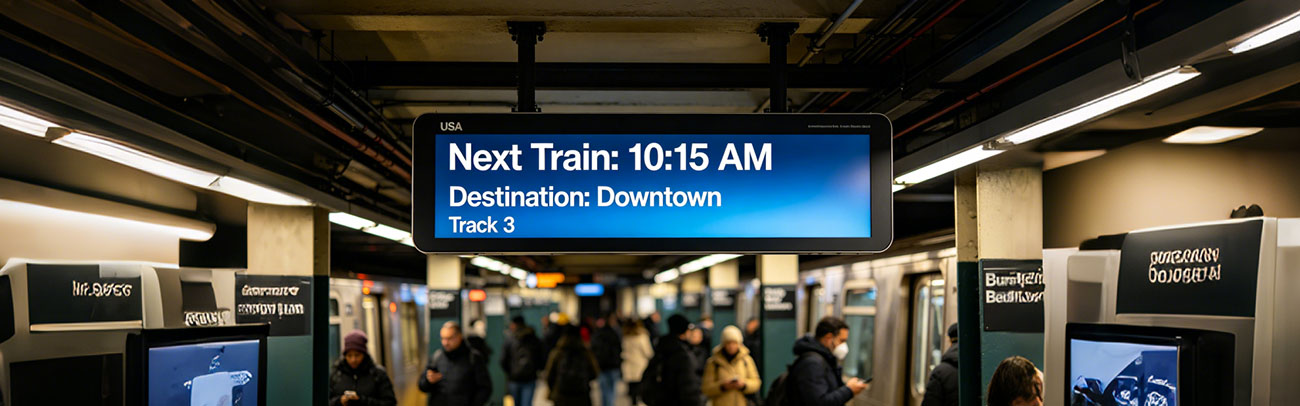
| 47" | 3840 × 1080 | 32:9 | Platform edge / station concourse |
| 23.1" | 1920 × 360 | 16:3 | Luggage rack strip, train carriage |
Unlike "cut-down" panels — which are standard LCD glass mechanically trimmed to a narrower dimension — native stretched panels are purpose-engineered from the backlight through to the driver IC. This distinction matters operationally: cut panels carry elevated risk of micro-fractures at the cut edge, light bleed at the terminus, and reduced MTBF under the vibration loads common in rail and road transit. Native panels from tier-1 manufacturers (BOE, Innolux, AUO) carry the same structural integrity rating as their standard-format equivalents.
For transit-grade procurement, specify native panel construction explicitly in your RFQ. It is the single most important line item for long-term reliability.
Technical Architecture: A PIS Integration Blueprint
A functional on-board PIS built on stretched bar displays is not simply a hardware selection exercise. It is a system integration problem, and the display is the output layer of a broader data pipeline.
1. Data Input Layer
The display must ingest real-time data from two primary sources:
AVL/GPS feed (Automatic Vehicle Location): Provides current position, which the system cross-references against a GTFS (General Transit Feed Specification) static schedule to calculate next stop, estimated arrival times, and connection information.
Dispatch/CAD system: Supplies service alerts, delay notifications, emergency messages, and operator-initiated content overrides.
In modern deployments, this data is pushed to the display controller via 4G/5G cellular modem (primary) with Wi-Fi handoff at termini for bulk content sync. The fallback is always pre-loaded static route content stored on the onboard media player, ensuring the display continues to show useful information even during connectivity loss — a scenario that occurs frequently in underground metro tunnels.
Protocol note: GTFS-Realtime over HTTP/protobuf is the current North American standard. European operators increasingly use SIRI (Service Interface for Real-time Information) XML feeds. A well-specified PIS display controller handles both, and procurement specs should require it.
2. Display Controller / Embedded Media Player
Each stretched bar unit integrates an embedded Android (12 or higher) or Linux-based media player. Minimum spec for a viable transit deployment:
SoC: Rockchip RK3568 or equivalent (quad-core ARM Cortex-A55, 2GHz)
RAM: 4 GB LPDDR4
Storage: 32 GB eMMC (sufficient for 72-hour offline content cache)
Interfaces: HDMI in, USB-A ×2, RJ45, RS485 (for legacy bus intercom integration)
OS: Android 12 or Debian-based Linux (Android preferred for CMS ecosystem compatibility)
The controller handles multi-zone content rendering: a single 3840×1080 panel is logically partitioned into independent zones — for example, a next-stop animation on the left 60%, a live clock on the right 20%, and a scrolling service alert ticker at the bottom edge. Each zone updates independently without requiring a full-screen content refresh.
3. Content Management System (CMS) Integration
Centralized fleet management operates through a cloud-based CMS that communicates with each vehicle's display controller via the cellular modem. Standard functionality includes:
Remote content push: Update promotional content, service maps, emergency notices across an entire fleet within minutes
Scheduling by route/vehicle/time-of-day: Rush-hour messaging differs from off-peak; door-side panels can show directional content based on which side of the vehicle is at the platform
Diagnostic telemetry: Display brightness, uptime, connectivity status, and fault codes reported back to the operations center in real time
OTA firmware updates: Critical for maintaining security compliance without requiring vehicles to be pulled from service
The CMS integration layer is where many deployments fail. The display must expose a documented API (REST or MQTT) for CMS connectivity, and the vendor must provide active SDK support. This is a procurement qualification criterion, not a nice-to-have.
4. Physical Integration and Mounting
Transit cabin installation introduces mechanical constraints that differ fundamentally from static retail or architectural signage environments:
Vibration tolerance: IEC 60068-2-64 specifies random vibration test profiles for transport equipment. Displays deployed on buses and rail cars must meet relevant sub-categories (road vehicles: 5–150 Hz swept sine; rail: EN 50155 Category 1). Request test certificates from any supplier as part of qualification.
Temperature range: Vehicle cabins can reach +65°C in summer (particularly in door-adjacent zones) and drop to -25°C in overnight storage in cold climates. The rated operating range for transit displays should be -20°C to +70°C at minimum, with storage ratings extending further.
Ingress protection: Bus header positions are exposed to passenger-generated humidity, cleaning fluid overspray, and occasional splash. IP54 minimum is appropriate; IP65 is preferable for driver-area or door-adjacent installations.
Mounting hardware: Overhead installations require anti-vibration isolation mounts. The display chassis should include integrated VESA-compatible mounting points and, for installations above seated passengers, secondary retention cables rated to a minimum of 5× the display weight — a requirement in most European and North American transit safety standards.
Brightness: Platform-edge and window-facing installations demand high-brightness panels. A minimum of 1,000 nits is required for legibility in direct sunlight ingress; 1,500 nits is the recommended specification for south-facing platforms in temperate climates.
Operational Performance: What the Numbers Look Like
A properly specified stretched bar PIS deployment delivers measurable outcomes across three dimensions:
Passenger experience: Real-time next-stop and connection information reduces passenger-initiated driver communications by approximately 40% in initial post-deployment periods (a figure consistently cited in transit authority operational reports from UK and Scandinavian networks following PIDS upgrades). For operators managing multi-language passenger populations, on-screen multilingual capability eliminates the need for separate text displays and reduces regulatory compliance overhead.
Operational efficiency: Dynamic content routing allows operators to redirect messaging in real time during service disruptions — re-routing instructions, alternative stop information, and emergency notices reach passengers on board before they reach the affected stop. This reduces platform crowding events and associated safety incidents.
Maintenance cost: A daisy-chain installation topology — one media player driving up to 12 displays via serial video output — reduces per-vehicle controller count from one per display (the legacy approach with independent monitors) to one per zone. Across a fleet of 200 vehicles, this reduction in controller hardware and associated cabling represents a significant lifecycle cost saving.
Common Deployment Pitfalls and How to Avoid Them
Pitfall 1: Specifying cut-panel displays to reduce unit costThe immediate cost saving is typically 15–25% per unit. The lifecycle cost penalty — from higher failure rates, more frequent warranty claims, and panel replacement at year 2–3 rather than year 5–7 — consistently exceeds the initial saving in transit deployments where vibration loads are continuous. Specify native panel construction.
Pitfall 2: Underspecifying the CMS APISelecting a display based on hardware spec alone, then discovering that the vendor's CMS is a closed ecosystem incompatible with the operator's existing fleet management platform, is the most common cause of project delay and cost overrun. Define CMS integration requirements — protocol, authentication, data schema — before shortlisting display vendors.
Pitfall 3: Ignoring EMC complianceDisplays in transit vehicles must meet electromagnetic compatibility standards to avoid interfering with radio communications equipment, passenger Wi-Fi, and ATC (Automatic Train Control) systems. In North America, FCC Part 15 applies; in Europe, EN 55032 is the relevant standard. Displays not tested and certified to these standards cannot legally be installed in commercial transit vehicles in most jurisdictions.
Pitfall 4: Oversizing for the spaceA 47" panel is not inherently superior to a 37.5" in a bus cabin. Oversizing increases weight load on the mounting structure, consumes more power (relevant for electric vehicle range calculations), and can compromise passenger headroom clearance requirements. Dimensional analysis against the specific vehicle model is a prerequisite for hardware selection, not an afterthought.
Procurement Checklist for Transit PIS Buyers
When issuing an RFQ for stretched bar display panels for a transit PIS application, require the following documentation from vendors:
Native panel construction confirmation from panel manufacturer (BOE, Innolux, AUO, or equivalent tier-1)
IEC 60068-2-64 vibration test certificate (specify relevant vehicle category)
Operating temperature range certificate (-20°C to +70°C minimum)
Ingress protection rating certificate (IP54 minimum)
EMC compliance certificate (FCC Part 15 / EN 55032 as applicable)
MTBF data at rated operating temperature (50,000 hours minimum for LED backlight)
CMS API documentation (REST/MQTT, authentication method, schema)
GTFS-RT and SIRI feed compatibility confirmation
Sample fleet reference (minimum 50 vehicles, 12 months operational)
Spare parts availability commitment (minimum 7 years post-purchase)
Conclusion
The stretched bar display is not simply a niche format curiosity. In transit PIS applications, it is the geometrically and technically correct solution to a problem that standard 16:9 displays cannot solve without compromising either the installation environment or the content experience. The technology is mature, the supply chain is established at scale, and the integration frameworks — GTFS-RT, SIRI, Android CMS, REST APIs — are well-documented.
The differentiating factor between a successful deployment and a costly retrofit is the thoroughness of specification at procurement. Operators and integrators who approach the display as a system component — defining vibration tolerance, CMS compatibility, EMC compliance, and panel construction type before selecting a vendor — consistently achieve the operational outcomes the technology is capable of delivering.
For transit networks currently operating static or legacy PIDS infrastructure, the business case for migration to native stretched bar LCD systems is robust. The hardware cost is recoverable; the passenger experience and operational efficiency gains are not achievable through any other means within the physical constraints of modern vehicle design.
For technical specifications, custom panel sizing, and fleet integration consulting, contact our engineering team to discuss your specific deployment requirements.