TECHNICAL APPLICATION WHITE PAPER
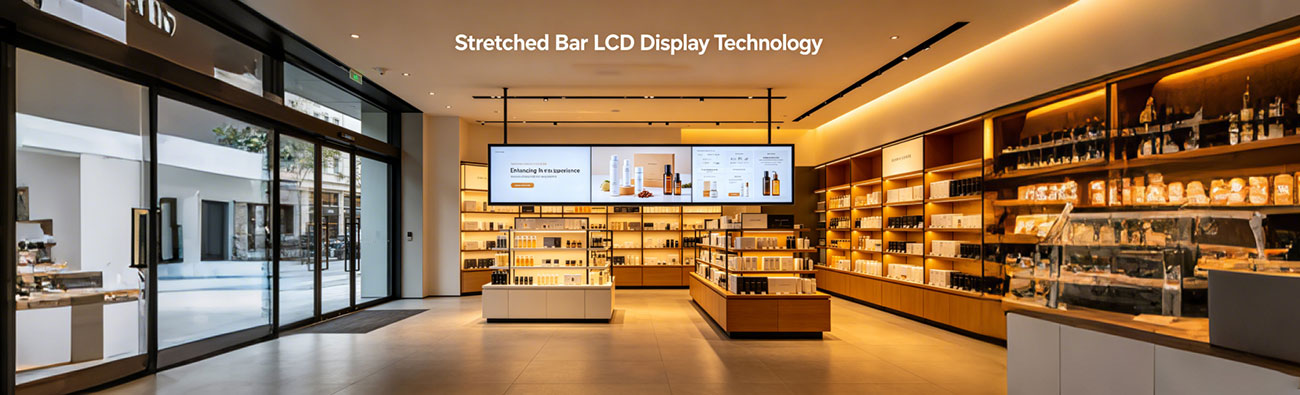
Stretched Bar LCD Display Technology
Transforming Retail Environments Through
High-Impact Visual Communication Solutions
Prepared by: Product Engineering & Solutions Team
Document Version: 3.2 | Publication Date: Q2 2026
Classification: Public – For Customer Distribution
 Executive Summary
The global retail industry is undergoing a fundamental transformation driven by the convergence of digital technology, evolving consumer expectations, and intensifying competition for customer attention. In this dynamic landscape, the ability to deliver targeted, visually compelling content at the point of decision has become a critical differentiator for retailers across all segments.
Stretched bar LCD displays represent a purpose-engineered response to this challenge. Combining an ultra-wide aspect ratio (typically 16:3 or 32:9), high-brightness optical performance, and ruggedized construction suited to 24/7 commercial operation, these displays are increasingly deployed as the cornerstone of modern retail digital signage strategies.
This white paper provides a comprehensive technical and commercial analysis of stretched bar LCD display technology, examining its architectural principles, performance characteristics, deployment methodologies, and demonstrated return on investment across key retail verticals. It is intended as a decision-support resource for retail technology directors, visual merchandising managers, and procurement specialists evaluating next-generation in-store display infrastructure.
Research indicates that digital point-of-sale displays increase average transaction value by 15–40% depending on product category, with stretched bar formats achieving particularly high recall rates due to their distinctive form factor and shelf-edge proximity.
1. Market Context & Industry Drivers
1.1 The Evolving Retail Display Landscape
Traditional static shelf-edge labels and printed POP materials are increasingly inadequate for meeting the demands of modern retail environments. Consumers expect dynamic, personalized, and contextually relevant information at every touchpoint, while retailers require the flexibility to update pricing, promotions, and product content in real time across distributed store networks.
The global digital signage market was valued at approximately USD 25.1 billion in 2023 and is projected to exceed USD 45 billion by 2030, driven by accelerating adoption across retail, hospitality, and transportation verticals. Within this market, purpose-built retail display form factors—including stretched bar, shelf-edge, and ultra-wide formats—are among the fastest-growing segments, as retailers move away from generic consumer-grade screens toward solutions engineered for specific commercial use cases.
1.2 Key Business Drivers
Several macro-level forces are driving investment in stretched bar LCD infrastructure:
• Omnichannel Integration: Retailers are investing in in-store digital touchpoints that mirror the personalization and dynamism of e-commerce, reducing the experiential gap between physical and digital channels.
• Pricing Agility: Supply chain volatility, inflation dynamics, and competitive pricing pressure demand near-real-time price management capabilities that static labels cannot support.
• Sustainability Mandates: ESG commitments are accelerating the phase-out of printed promotional materials, with digital displays offering a measurable reduction in paper consumption and waste.
• Labor Efficiency: Centralized content management systems connected to stretched bar display networks dramatically reduce the labor cost associated with manual price and promotion updates.
• Data-Driven Merchandising: Integration of display networks with analytics platforms enables A/B testing of promotional content, dayparting strategies, and performance measurement at the individual fixture level.
2. Technology Architecture & Display Fundamentals
2.1 Form Factor Definition & Optical Geometry
A stretched bar LCD display is characterized by its extreme aspect ratio, typically ranging from 7:1 to 32:3, which produces a horizontal bar format optimized for shelf-edge, under-cabinet, and aisle-facing installations. Common panel resolutions include 1280×360, 1920×540, and 3840×1080 pixels, with physical diagonals typically ranging from 14 to 58 inches.
The optical geometry of stretched displays is engineered to maximize horizontal viewing angles—critical for aisle-facing retail installations—while maintaining vertical brightness uniformity across the full panel width. Advanced optical bonding techniques eliminate the air gap between the LCD panel and the front glass, substantially reducing internal reflections and improving contrast in high-ambient-light retail environments.
2.2 Technical Specifications Overview
The following table summarizes the key performance parameters of commercial-grade stretched bar LCD displays:
Panel Technology | IPS (In-Plane Switching) or VA (Vertical Alignment) LCD |
Aspect Ratios | 7:1, 16:3, 32:9, 32:3 (custom ratios available) |
Native Resolutions | 1280×360 / 1920×540 / 3840×1080 pixels |
Screen Sizes | 14", 19", 23", 28", 37", 47", 58" diagonal |
Brightness (Standard) | 400–700 cd/m² (nits) |
Brightness (High-Bright) | 1,000–2,500 cd/m² (outdoor/high-ambient) |
Contrast Ratio | 1,000:1 – 4,000:1 (static); up to 50,000:1 (dynamic) |
Color Gamut | 72–90% NTSC; sRGB calibrated |
Viewing Angles | 178° H / 178° V (IPS panels) |
Operating Temperature | -20°C to +60°C (extended: -40°C to +70°C with thermal management) |
Operating Hours | 50,000–100,000 hours MTBF |
Ingress Protection | IP42 (standard) to IP65 (outdoor/wash-down rated) |
Input Interfaces | HDMI 2.0, DisplayPort 1.4, USB-C, RJ45 (LAN), RS232 |
Onboard Processing | Android 11/12 SoC or Windows IoT optional integrated player |
Power Consumption | 12W – 65W depending on size and brightness |
Certifications | CE, FCC, RoHS, UL, Energy Star (select models) |
2.3 Integrated vs. External Media Player Architecture
Stretched bar displays are available in two primary system architectures, each with distinct advantages depending on deployment scale and management requirements:
2.3.1 System-on-Chip (SoC) Integrated Player
SoC-integrated models embed the media player directly into the display unit, eliminating external hardware dependencies. The integrated SoC typically delivers quad-core ARM processing at 1.8–2.0 GHz with 2–4 GB RAM and 16–32 GB eMMC storage. This architecture reduces installation footprint, lowers total cost of ownership, and simplifies maintenance in high-density deployments.
2.3.2 External Player Architecture
Installations requiring more intensive content processing—such as 4K video playback, real-time data integration, or AI-driven content personalization—benefit from external player configurations. External players based on Intel NUC or NVIDIA Jetson platforms provide substantially greater computational resources, enabling advanced analytics, facial detection for audience measurement, and complex CMS integrations.
2.4 Thermal Management & Reliability Engineering
The operational demands of 24/7 retail environments impose rigorous thermal management requirements on display hardware. Commercial-grade stretched bar displays incorporate multi-zone thermal monitoring, variable-speed fan systems (or fanless passive cooling in sealed units), and automatic brightness throttling to maintain panel temperatures within validated operating ranges.
Accelerated life testing protocols validate panel performance across 50,000–100,000 operating hours, with MTBF figures independently certified to IEC 60068 environmental test standards. This engineering rigor translates to annualized failure rates well below 1% in typical retail deployments, minimizing both replacement costs and customer-facing display downtime.
3. Retail Application Scenarios
3.1 Shelf-Edge Electronic Shelf Label (ESL) Replacement & Enhancement
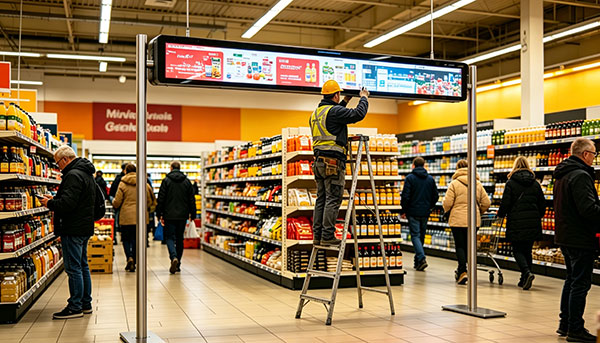
The most common deployment of stretched bar displays in food retail, pharmacy, and consumer electronics is as dynamic shelf-edge labels. Unlike traditional ESL systems, which are constrained to minimal text and numeric content, stretched bar displays support full-motion video, animated graphics, and richly formatted promotional messaging at the point of product selection.
Deployment typically involves 19"–28" diagonal units mounted horizontally at shelf face level, either surface-mounted to standard gondola uprights or integrated into custom-fabricated shelf systems. Content management systems synchronized with POS and inventory databases enable automatic price updates, out-of-stock indicators, and promotion activation without staff intervention.
A leading European grocery chain deployed stretched bar shelf-edge displays across 320 stores, achieving 97.3% pricing accuracy (vs. 91.2% with manual label management) and a 23% reduction in promotional compliance errors within the first 12 months of operation.
3.2 Queue Management & Checkout Zone Engagement
Checkout and queue zones represent high-dwell-time locations where stretched bar displays deliver outsized engagement impact. Mounted above conveyor belts, at eye level alongside queue barriers, or integrated into self-checkout kiosk surrounds, these displays present last-chance purchase suggestions, loyalty program messaging, and brand communications during the critical pre-payment moment.
The narrow vertical footprint of bar-format displays makes them particularly suitable for the space-constrained checkout environment, where ceiling heights and sightline considerations limit the practical installation of conventional square-format screens.
3.3 End-Cap & Category Entry Signage
Gondola end-caps and category entry points are prime real estate for brand and promotional communication. Stretched bar displays at these locations serve dual functions: as attention-capturing dynamic signage visible from distance, and as informational displays delivering product comparisons, recipe content, or brand storytelling at close range. Installations typically use 37"–58" diagonal units in landscape orientation, often in multi-screen vertical stacks to create a larger visual canvas.
3.4 Fashion Retail: Rail-Top & Fitting Room Applications
In apparel and fashion retail, stretched bar displays mounted above clothing rails provide an elegant, space-efficient solution for brand video, lookbook content, and care instruction delivery. The horizontal format mirrors the proportions of the clothing rail itself, creating a visually cohesive display environment without the intrusive footprint of conventional screens.
Fitting room applications use displays mounted above mirrors or integrated into door panels to deliver personalized styling suggestions triggered by RFID-tagged garments, or to present brand content that reinforces premium positioning during the high-consideration try-on moment.
3.5 Automotive Retail & Dealership Showrooms
Automotive dealerships are deploying stretched bar displays along vehicle bonnet lines and door sills to display real-time pricing, financing calculators, and model specification comparisons. The form factor aligns naturally with vehicle proportions, creating an integrated digital information layer that enhances the premium showroom experience without disrupting the visual presentation of the vehicle itself.
4. Content Management System Integration
4.1 Enterprise CMS Architecture
Effective deployment of stretched bar display networks at scale requires robust CMS infrastructure capable of managing content distribution, scheduling, and monitoring across hundreds or thousands of endpoints. Enterprise CMS platforms designed for retail digital signage typically provide:
• Hierarchical content organization supporting zone, store, region, and network-level targeting
• Role-based access control enabling store managers, regional teams, and central marketing to maintain appropriate content authority
• Real-time device health monitoring with automated alerting for display failures, connectivity loss, or content playback errors
• Proof-of-play reporting with timestamp-accurate playback logs for promotional compliance documentation
• API-first architecture enabling integration with ERP, PIM, POS, and loyalty management systems
4.2 Data Integration Patterns
The operational value of stretched bar display networks is maximized when content is dynamically generated from live business data sources. The following integration patterns are commonly implemented in enterprise retail deployments:
Integration Type | Data Source | Content Output | Update Frequency |
Price Feed Integration | ERP / POS System | Dynamic price overlays | Real-time / Near real-time |
Inventory Status | WMS / Stock System | Availability indicators | Every 15–60 minutes |
Promotion Management | Trade Promotion Mgmt | Promotional creative | Campaign-scheduled |
Weather Triggers | Weather API | Contextual product upsell | Hourly |
Audience Analytics | In-store camera AI | Targeted content variants | Real-time |
Loyalty Integration | CRM Platform | Personalized offers | Session-triggered |
4.3 Network Infrastructure Requirements
Stable and low-latency network connectivity is a fundamental prerequisite for reliable CMS-managed display operation. The following infrastructure specifications are recommended for enterprise-grade deployments:
• Minimum 10 Mbps dedicated bandwidth per 50 display endpoints for standard definition content
• Gigabit Ethernet backbone with PoE+ (IEEE 802.3at) support for simplified installation where power and data can share a single cable run
• VLAN segmentation isolating display network traffic from corporate and POS systems
• Local edge caching servers at the store level to minimize WAN dependency and ensure content availability during connectivity interruptions
• 802.11ac (Wi-Fi 5) or 802.11ax (Wi-Fi 6) wireless for installations where cabled infrastructure is impractical
5. Deployment Methodology & Best Practices
5.1 Site Survey & Installation Planning
Successful deployment of stretched bar display systems begins with comprehensive site surveys that document structural mounting surfaces, available power circuits, data network access points, ambient light levels, and customer traffic flow patterns. These surveys inform display placement, brightness specification, and content strategy decisions that determine the effectiveness of the final installation.
Key site survey parameters include measurement of ambient illuminance (lux) at the installation point across different trading hours, assessment of direct sunlight or high-intensity spot lighting that may impact contrast performance, and structural load analysis for ceiling or overhead mounting configurations.
5.2 Mounting Systems & Integration Hardware
Stretched bar displays are designed for integration with a wide range of mounting and fixture systems:
• Standard VESA mount compatibility (75×75mm to 200×200mm) for universal bracket compatibility
• Custom gondola integration brackets with tool-free cable management designed for grocery and mass retail environments
• Slimline surface mount profiles with integrated cable channels for flush-to-shelf installation
• Suspended ceiling mount systems for overhead aisle-facing installations
• Kiosk integration kits for self-service and interactive display configurations
5.3 Commissioning & Quality Validation
Post-installation commissioning should validate the following performance parameters against project acceptance criteria:
• Panel brightness uniformity: maximum ±15% variation across the display surface measured at 9 points
• Color temperature consistency: ±200K deviation from specified white point (typically 6500K)
• CMS connectivity: confirmed registration of all endpoints within the management platform
• Content playback verification: full playlist cycle confirmed on each display
• Viewing angle validation: content legibility confirmed at specified maximum viewing distances and angles
6. Return on Investment Framework
6.1 Revenue Impact Metrics
Quantifying the commercial impact of stretched bar display investments requires a structured measurement framework that captures both direct revenue uplift and indirect operational efficiencies. The following metrics framework is recommended for retail deployment evaluation:
KPI Category | Metric | Typical Improvement Range | Measurement Method |
Revenue | Promoted item sales uplift | +15% to +40% | A/B store comparison |
Revenue | Average basket value | +3% to +12% | POS transaction analysis |
Revenue | Conversion rate (category) | +5% to +18% | Traffic counter + POS |
Compliance | Promotional pricing accuracy | +6% to +15% pts | Price audit sampling |
Efficiency | Promo label labor reduction | 60%–80% hours saved | Labor time study |
Efficiency | Price update cycle time | Hours → Minutes | Process timing |
Sustainability | Print material elimination | 70%–95% reduction | Print volume tracking |
6.2 Total Cost of Ownership Analysis
A comprehensive TCO analysis for a 100-store deployment of stretched bar displays across a typical grocery network (average 40 units per store) illustrates the financial case:
• Hardware acquisition: $280–$420 per display unit (23" SoC-integrated, commercial grade)
• Installation labor: $85–$150 per unit for standard gondola integration
• CMS licensing: $0.50–$1.20 per display per month for cloud-managed enterprise platform
• Network infrastructure: $2,500–$8,000 per store for Ethernet cabling and edge hardware
• Annual maintenance: 8–12% of hardware cost (comprehensive parts-and-labor contract)
Against these costs, a retailer managing 40 displays per store with weekly promotional updates can anticipate labor savings equivalent to 3–5 FTE hours per store per week at current wage rates, yielding annualized labor savings that typically recover hardware investment within 18–30 months in medium-density deployments.
Independent lifecycle analysis across 12 retail deployments managed by our solutions team demonstrated a median payback period of 22 months, with five-year NPV exceeding 3.2× the initial capital investment when accounting for combined revenue uplift and operational savings.
7. Application Case Studies
7.1 Case Study: European Hypermarket Chain – Shelf-Edge Digitization
Sector: Food Retail | Deployment Scale: 180 stores | Display Count: 14,400 units
Challenge: A major hypermarket operator with stores across seven European markets was experiencing significant promotional compliance failures, with an estimated 8.5% of shelf positions displaying incorrect pricing or outdated promotional materials at any given time. Manual label management across 80,000+ SKUs was consuming approximately 2,400 labor hours per week across the store network.
Solution: Deployment of 23" stretched bar LCD displays integrated with the retailer's SAP-based ERP system via a purpose-built CMS connector. Real-time price feed synchronization ensured display content updated within 90 seconds of any ERP price change. Motion-triggered promotional content activated consumer attention during periods of peak foot traffic.
Outcomes after 18 months of operation:
• Pricing compliance improved from 91.5% to 98.7%
• Promotional labor reduced by 1,850 hours per week across the network
• Average basket value on featured categories increased 19.3%
• Carbon footprint reduction: 84 metric tons of paper consumption eliminated annually
7.2 Case Study: Premium Electronics Retailer – Interactive Category Experience
Sector: Consumer Electronics | Deployment Scale: 42 flagship stores | Display Count: 1,260 units
Challenge: A premium consumer electronics retailer sought to differentiate its in-store experience from online competitors and mass-market retailers by delivering deeper product education and brand storytelling at the category level.
Solution: 37" stretched bar displays deployed in 3-unit vertical stacks at category entry points, integrated with product information management (PIM) system to deliver model comparison content, video reviews, and specification data. NFC-enabled interactive triggers allowed customers to pull detailed specification sheets to their smartphones.
Outcomes after 12 months:
• Product attach rate (accessories per transaction) increased 34%
• Average selling price on featured categories increased 11.2%
• Customer satisfaction scores (NPS) in relevant categories increased 18 points
• Staff product knowledge query volume reduced 28%, enabling reallocation to service activities
8. Sustainability & ESG Considerations
The transition from print-based retail communication to digital display networks delivers material environmental benefits that are increasingly relevant to corporate ESG reporting obligations. Key sustainability metrics associated with stretched bar display deployment include:
8.1 Materials & Waste Reduction
A typical 100-store grocery network consuming 2 million promotional labels annually generates approximately 8–12 metric tons of paper waste, plus chemical waste from label adhesives and printing consumables. Full digitization of shelf-edge communication eliminates this waste stream, with a corresponding reduction in supply chain carbon emissions from print production and distribution logistics.
8.2 Energy Efficiency Design
Contemporary commercial-grade stretched bar displays incorporate multiple energy optimization features:
• Ambient light sensors enabling automatic brightness adjustment to maintain visual performance while minimizing power consumption
• Schedule-based dimming aligned with store trading hours
• Intelligent sleep modes during non-trading periods with rapid wake capability
• LED backlight technology achieving energy consumption reductions of 60–70% compared to CCFL-backlit predecessors
At the system level, a 40-display store installation consuming an average of 25W per display (typical for 23" SoC units at 400 nit brightness) draws approximately 1 kW at full operation—comparable to a small number of fluorescent shelf-edge lighting fixtures and representing a minimal contribution to overall store energy consumption.
9. Vendor & Product Selection Criteria
Organizations evaluating stretched bar display solutions for retail deployment should apply the following structured evaluation framework to ensure technology selections meet both immediate deployment requirements and long-term strategic needs:
Evaluation Criterion | Key Assessment Questions | Weight |
Panel Performance | Does brightness meet worst-case ambient light conditions? Is color uniformity validated? | High |
Reliability & MTBF | Are failure rate claims independently certified? What is the warranty and replacement SLA? | High |
CMS Compatibility | Does the display support your preferred CMS platform? Are APIs open and documented? | High |
Scalability | Can the vendor support full network deployment within required timelines? | Medium |
Technical Support | Is on-site support available in all required geographies? What are SLA commitments? | Medium |
Total Cost of Ownership | What is the fully loaded 5-year cost including hardware, installation, and support? | Medium |
Sustainability Profile | Are energy certifications current? Is end-of-life recycling supported? | Medium |
Future Roadmap | Is the vendor investing in next-generation features (AI content, touch, analytics)? | Low |
10. Emerging Technologies & Future Outlook
10.1 AI-Driven Content Personalization
The integration of edge AI processing with stretched bar display networks is enabling a new generation of context-aware content delivery. Computer vision systems analyzing anonymized customer presence and dwell time data can dynamically select and sequence content variants in real time, moving beyond static playlist scheduling to genuinely responsive in-store communication. Early deployments of AI-optimized content in retail environments are demonstrating engagement lifts of 25–45% compared to conventional dayparting-based scheduling approaches.
10.2 Transparent & Flexible Display Technology
Transparent OLED and MicroLED display technologies are beginning to emerge as premium alternatives for showcase and high-visibility retail applications. While current pricing limits deployment at scale, transparent displays integrated into refrigerator doors and product showcase cases represent a natural evolution of the stretched bar form factor into fully immersive display environments. Cost reduction trajectories suggest mainstream retail viability within 3–5 years.
10.3 Unified Commerce Analytics Integration
As retail organizations mature their data infrastructure, stretched bar display networks are increasingly positioned as active nodes in the unified commerce analytics ecosystem. Sensor fusion combining display audience measurement, dwell time analysis, and POS correlation is enabling granular attribution of in-store display investment to specific sales outcomes—a capability that brings digital signage investment justification to the same level of rigor as digital advertising performance measurement.
11. Conclusion & Recommendations
Stretched bar LCD display technology has matured from a niche format curiosity to a proven, enterprise-grade infrastructure component for retail visual communication. The convergence of purpose-engineered hardware, robust commercial-grade reliability, and sophisticated CMS integration capabilities has created a technology platform that delivers measurable, attributable business value across retail formats and categories.
For organizations evaluating investment in this technology, the following recommendations reflect best practice derived from successful large-scale deployments:
• Begin with a structured pilot program across 10–20 stores encompassing diverse format types, incorporating rigorous A/B comparison measurement before committing to full network rollout.
• Prioritize CMS platform selection and integration architecture before hardware procurement—the management system is the long-term value creator; the display hardware is its delivery mechanism.
• Specify commercial-grade hardware with validated MTBF ratings and comprehensive support SLAs; consumer-grade displays will not sustain 24/7 retail operational demands.
• Develop a content strategy framework before deployment, including templates, data integration specifications, and governance processes for content approval and scheduling.
• Establish baseline KPI measurements (basket value, conversion rate, promotional compliance, labor hours) prior to deployment to enable rigorous post-deployment impact quantification.
Organizations that approach stretched bar display investment with this level of strategic rigor consistently achieve the upper range of the ROI metrics documented in this paper, and position themselves to extract additional value as AI content optimization and unified analytics capabilities continue to mature.
To discuss deployment requirements, request reference site visits, or obtain a detailed commercial proposal for your organization's specific needs, please contact our retail solutions team. We bring extensive experience across food retail, fashion, consumer electronics, and automotive verticals to support your evaluation and deployment process.
Appendix A: Glossary of Technical Terms
Aspect Ratio | The proportional relationship between display width and height. Stretched bar displays typically feature ratios of 7:1 to 32:3. |
Brightness (Luminance) | Measured in candelas per square meter (cd/m², commonly nits). Higher values are required in high ambient light environments. |
CMS | Content Management System. Software platform for creating, scheduling, and distributing content to display networks. |
Contrast Ratio | The ratio between the brightest white and darkest black a display can produce. Higher ratios indicate better visual depth. |
ESL | Electronic Shelf Label. A digitally managed label system for displaying pricing and product information at the shelf edge. |
IPS Panel | In-Plane Switching LCD panel technology offering wide viewing angles and accurate color reproduction. |
MTBF | Mean Time Between Failures. A reliability metric representing the average operating time expected between failures. |
Nits | Informal unit of luminance equivalent to cd/m². A standard retail display operates at 400–700 nits; high-bright models at 1,000–2,500 nits. |
PoE+ | Power over Ethernet Plus (IEEE 802.3at). Delivers up to 30W of power over standard network cabling, simplifying display installation. |
SoC | System-on-Chip. An integrated circuit that combines processor, memory, and I/O interfaces, enabling standalone media playback within the display unit. |
TCO | Total Cost of Ownership. Comprehensive cost analysis encompassing hardware, installation, software, maintenance, and operational costs over a defined period. |
VESA Mount | A standardized mounting interface (Video Electronics Standards Association) enabling compatibility between displays and mounting hardware. |
— End of Document —
For technical inquiries, contact: solutions@company.com