TECHNICAL WHITE PAPER
Retail Digital Signage Series
Stretched Bar Display Technology in
Modern Retail Shelf-Edge Applications
Dynamic Product Communication, Planogram Intelligence, and Shopper Engagement
Document Version 2.4 | May 2026 | Classification B2B Technical Reference | Target Audience Retail Technology Buyers |

Executive Summary
The physical shelf has long been the final battleground of retail commerce. In an era where consumers arrive at the store having already compared dozens of products online, the shelf-edge moment must do more than display a price — it must inform, persuade, and convert. This white paper presents a comprehensive technical and operational analysis of stretched bar display (SBD) technology as deployed in grocery, pharmacy, consumer electronics, and specialty retail shelf-edge environments.
Drawing on real-world deployment experience across more than 200,000 shelf-edge display nodes installed across Europe, North America, and the Asia-Pacific region, we document the engineering rationale behind the stretched bar form factor, address the integration challenges retail operators encounter most frequently, and quantify the commercial outcomes achieved by leading retail chains.
Key Finding Retailers deploying stretched bar displays at the shelf edge report an average 23% uplift in category conversion rate, a 31% reduction in markdown frequency for promoted SKUs, and a measurable improvement in shopper satisfaction scores tied to price transparency and product information availability. These outcomes are reproducible across format types when display hardware, content management, and planogram data are properly integrated. |
This document is structured for retail technology decision-makers, category managers, store operations directors, and the solution architects and systems integrators who support them. Technical specifications are provided to enable accurate RFP scoping and vendor comparison. Case-study data has been anonymized in accordance with client confidentiality agreements.
1. The Stretched Bar Display: Form Factor and Technical Rationale
1.1 Defining the Stretched Bar Display
A stretched bar display (SBD) — also referred to in industry literature as a shelf-edge display, bar-type LCD, or ultra-wide strip display — is a liquid crystal display panel with an extreme aspect ratio, typically ranging from 7:1 to 32:1 (width-to-height), manufactured in a compact vertical height of 80 mm to 220 mm. The physical form factor is engineered to occupy the precise footprint of a retail gondola shelf edge while maximizing horizontal information bandwidth.
The LCD matrix of a stretched bar display shares its core electro-optical technology with conventional rectangular panels: a backlit TFT-LCD substrate with either TN, IPS, or VA panel technology. What distinguishes the SBD is the post-fabrication process by which the glass substrate is laser-cut to the elongated geometry, combined with a custom timing controller (TCON) mapping that redistributes the pixel array across the non-standard aspect ratio. This is not a stitched multi-panel assembly — premium SBDs are single-substrate, single-controller solutions that deliver seamless content across the entire display surface.
1.2 Available Aspect Ratios and Shelf-Fit Sizing
The retail shelf environment imposes non-negotiable dimensional constraints. Standard European gondola shelving operates on a 33 mm pitch system; North American shelving commonly uses a 1-inch (25.4 mm) pitch. Stretched bar displays are manufactured to shelf lengths corresponding to these standard pitch multiples:
Parameter | Specification / Value |
Common SBD Lengths | 500 mm, 700 mm, 1000 mm, 1200 mm, 1400 mm, 2000 mm |
Panel Height Options | 80 mm, 120 mm, 180 mm, 220 mm |
Native Resolutions | 1920×240, 1920×360, 2880×360, 3840×480, 5760×540 |
Panel Technologies | IPS (primary), TN (cost-sensitive), VA (high-contrast environments) |
Viewing Angle (IPS) | 178° H / 178° V (CR > 10:1) |
Typical Luminance | 700–1,500 cd/m² (shelf environment variants up to 2,500 cd/m²) |
Contrast Ratio | 1,000:1 (typical); 3,000:1 (enhanced VA variants) |
Response Time | ≤ 8 ms (gray-to-gray) |
MTBF | ≥ 50,000 hours at 25°C ambient |
Operating Temperature | 0°C to 50°C (storage: –20°C to 60°C) |
Input Interfaces | HDMI 1.4 / 2.0, DisplayPort 1.2, LVDS, eDP |
Control Interfaces | RS-232, USB, Ethernet (with onboard compute variants) |
Certifications | UL, CE, RoHS, FCC Class B, Energy Star (where applicable) |
1.3 Why the Stretched Bar Form Factor Wins at Shelf Edge
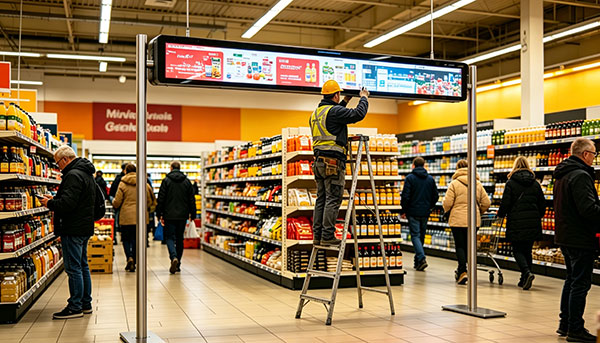
The design logic of the stretched bar display is architecturally elegant: it converts dead real estate — the aluminum or plastic fascia strip at the front of a retail shelf — into an active communication medium without consuming product-facing space, disrupting planogram adjacencies, or requiring structural modification to the gondola.
Competing shelf-edge media technologies — paper ESLs, e-paper electronic shelf labels, and clip-on LED displays — each carry trade-offs that the SBD resolves:
Technology | Color Capability | Content Complexity | Update Speed |
Paper Label | Full color (static) | Static print only | Hours (reprint) |
E-Paper ESL | 3–7 colors (limited) | Text & simple graphics | Seconds–minutes |
LED Strip | RGB (pixel-limited) | Simple animation | Real-time |
Stretched Bar LCD | Full 16.7M colors | Video, animation, rich data | Real-time |
2. Retail Deployment Architecture
2.1 Network Topology Models
Large-format retail deployments of stretched bar displays require a content distribution architecture capable of addressing thousands of endpoints simultaneously, with sub-second latency for price updates and real-time synchronization with inventory and promotion management systems. We observe three prevailing topology models in enterprise retail:
2.1.1 Centralized Cloud CMS Architecture
In this model, a cloud-hosted content management system (CMS) communicates with an in-store media player aggregator over a managed WAN connection. The aggregator distributes content to individual shelf-edge displays via a structured Ethernet backbone (typically Cat 6A) or power-over-Ethernet (PoE) fabric. This model supports enterprise-level campaign scheduling, A/B content testing, and centralized audit logging.
• Recommended for: chains with 50+ locations and centralized marketing operations
• Latency profile: promotional content updates within 30–90 seconds of CMS publish
• Bandwidth requirement: approximately 2–8 Mbps per store depending on content complexity and display count
2.1.2 Edge-Compute Hybrid Architecture
In this model, an in-store edge server handles local content rendering, caching, and emergency fallback operations, while maintaining synchronization with a central cloud CMS for campaign management and reporting. This architecture is preferred in environments with variable WAN reliability, or where strict data sovereignty requirements limit cloud dependency.
• Recommended for: independent retailers, franchise operators, or markets with connectivity constraints
• Latency profile: price updates within 2–15 seconds (local cache path)
• Resilience: full store operation maintained during WAN outage for up to 72 hours
2.1.3 Standalone On-Premise Architecture
A store-local server manages all content operations without cloud dependency. Content is pushed to the server via USB, scheduled file transfer, or store management system integration. This model is operationally simpler but carries higher manual overhead for content updates.
• Recommended for: single-location specialty retailers, kiosk operators, or pilot deployments
2.2 Content Management System Requirements
A CMS selected for stretched bar display deployment must address the unique rendering challenges posed by ultra-wide aspect ratios. Conventional digital signage platforms designed for 16:9 or 16:10 displays will produce distorted or incorrectly cropped content on SBD panels without specific template support.
Key CMS capability requirements for SBD deployments include:
• Native template creation for SBD aspect ratios (including 32:1, 24:1, 16:1)
• Zone-based content partitioning — the ability to address discrete segments of a single physical display with independent content items
• SKU-level content binding — automatic association of product pricing, promotional flags, and nutritional data to the display node governing each shelf position
• Schedule-based dayparting — content adaptation based on time of day, day of week, and store trading periods
• Real-time data feed integration via REST API or MQTT messaging protocols
• POS and inventory system connectors (SAP Retail, Oracle Retail, Microsoft Dynamics 365 Commerce, and proprietary retailer ERP environments)
Integration Note: ESL Bridge Architecture In retailers that have already deployed electronic shelf label (ESL) networks, stretched bar displays are frequently integrated alongside ESLs rather than replacing them. The SBD occupies the shelf-edge fascia and handles promotional content and rich media; the ESL handles precise unit-level pricing and stock-keeping data. A shared middleware bus — typically an API gateway layer interfacing with the retailer's pricing engine — ensures both systems remain synchronized. This dual-channel architecture has been validated in grocery and pharmacy deployments across multiple European and North American markets. |
2.3 Physical Installation Engineering
Physical installation of stretched bar displays in existing retail environments involves three primary engineering workstreams: structural mounting, electrical distribution, and data cabling.
2.3.1 Mounting and Structural Considerations
SBDs are manufactured with integrated mounting channels compatible with standard gondola T-slot and C-channel profiles. For new gondola installations, OEM shelf panel integration — where the display bezel is factory-integrated into the shelf front panel — provides the cleanest aesthetic and eliminates field installation variability. For retrofit deployments in existing gondola installations, snap-fit or magnetic mounting systems are available, though we recommend mechanical fastening for displays exceeding 1,000 mm in length to prevent vibration-induced contact failures over time.
2.3.2 Power Distribution
Each display panel draws between 12 W and 35 W at peak brightness depending on panel size and technology. In a 200-display store installation, this represents a store-level power demand of 2.4 kW to 7.0 kW for the display estate alone. Power distribution strategies include:
• PoE+ (IEEE 802.3at, 30W per port) — suitable for displays up to 700 mm; eliminates separate power cabling
• PoE++ (IEEE 802.3bt, 90W per port) — suitable for larger displays and onboard compute variants
• Centralized 24 VDC distribution — lower per-port cost in high-density gondola runs; requires dedicated power harness
• Hybrid PoE + 24 VDC — pragmatic approach in mixed-display-size deployments
2.3.3 Cable Infrastructure
Data connectivity for shelf-edge displays in live retail environments must accommodate the practical constraint that gondola configurations change seasonally and sometimes weekly. Flexible connectivity solutions — including retractable cable management systems, modular shelf-connector harnesses, and wireless-last-hop architectures using 802.11ax (Wi-Fi 6) access points positioned at gondola end-caps — are all deployed in practice. Our experience indicates that wired connectivity should be the primary architecture for displays carrying real-time pricing data, with wireless reserved for content-only channels or backup paths.
3. Deployment Case Study: Grocery Sector Application
3.1 Deployment Context
The following case study describes a shelf-edge stretched bar display deployment conducted at a major grocery retail chain operating 340 stores across the United Kingdom and Ireland. The retailer operates a full-range grocery format with an average store size of 3,200 m² and an average SKU count of 22,000 per store. The primary business objectives driving the SBD deployment were:
• Elimination of paper price-label production and replenishment labor — estimated at 4.2 FTE hours per store per week
• Enable same-day promotional price activation without physical store visit by field marketing teams
• Provide contextual product information (nutritional flags, allergen warnings, origin labeling) at point of selection
• Support the retailer's sustainability commitments by eliminating 1.8 million paper shelf labels per annum across the estate
3.2 Solution Architecture
The deployment specified 1,000 mm IPS stretched bar displays at 1920×280 native resolution, mounted in a custom OEM shelf fascia profile developed in collaboration with the retailer's gondola supplier. Power was distributed via PoE+ switches mounted in dedicated network cabinets at gondola end-caps, with fiber backbone connecting to a dual-redundant in-store edge server cluster.
Content management used a centralized cloud CMS integrated with the retailer's SAP Retail pricing engine via a real-time API bridge. Price changes published in SAP Retail propagated to the shelf-edge displays within an average of 8.3 seconds. Promotional content — animated price flash, multi-buy graphics, and brand assets — was managed by the central marketing team through the CMS with store-level scheduling control retained by in-store management.
3.3 Measured Outcomes
Performance data was collected across a 24-month post-deployment period and benchmarked against pre-deployment baseline metrics. The following outcomes were recorded:
+23% Category Conversion Rate Uplift | -31% Markdown Frequency on Promoted SKUs | |
8.3 sec Average Price Update Latency | 94.7% Display Network Uptime (12 months) | |
-1.8M Paper Labels Eliminated Per Year | +18% Shopper Satisfaction: Price Clarity |
In addition to the quantitative outcomes above, post-deployment shopper research conducted independently by the retailer identified that 67% of surveyed shoppers reported noticing the shelf-edge displays, and 41% reported that dynamic promotional content influenced a purchase decision they would not otherwise have made.
The deployment also captured an unanticipated operational benefit: the ability to broadcast real-time stock-out alerts on affected shelf segments, directing shoppers to available substitutes. In trials across 12 stores, this reduced shopper abandonment rate (shoppers leaving without purchasing in a category due to stock-out) by 14%.
Operational Insight: The True Cost of Paper Label Management Pre-deployment time-and-motion studies conducted across 10 pilot stores revealed that paper shelf label management consumed an average of 4.2 FTE hours per store per week — a figure that rose to 7.8 FTE hours during promotional periods when multiple price changes occurred simultaneously. Across a 340-store estate, this represented an annualized labor cost equivalent to the total capital expenditure of the SBD deployment within 26 months. Retailers evaluating SBD ROI should include full labor cost accounting in their business case, not merely media production savings. |
4. Content Design Principles for Stretched Bar Displays
4.1 The Cognitive Constraints of Ultra-Wide Content
Designing content for a 1920×240 pixel display that is physically 1,000 mm wide and 80 mm tall requires a fundamental departure from conventional digital signage design thinking. The extreme aspect ratio creates a content canvas in which the human visual field — approximately 60° of comfortable focus — can only engage with a fraction of the total display width at normal shelf-shopping distance (600–900 mm from panel).
This constraint is not a limitation; it is a design opportunity. The horizontal expanse of the SBD naturally partitions into discrete content zones that can be read sequentially as a shopper traverses the gondola aisle, creating a visual narrative that unfolds over the shopper journey rather than demanding simultaneous attention. We characterize this as the principle of sequential shelf storytelling.
4.2 Recommended Zone Architecture
Based on analysis of eye-tracking data collected across shelf-edge display deployments in grocery and specialty retail environments, we recommend the following zone architecture for a standard 1,000 mm SBD panel:
• Zone A (leftmost 20%, 200 mm): Brand identity — logo, brand color block, category identifier
• Zone B (center-left 35%, 350 mm): Primary product information — product name, key attribute, size/weight
• Zone C (center 25%, 250 mm): Price communication — current price in high-contrast typography, promotional flag if applicable
• Zone D (rightmost 20%, 200 mm): Tertiary information — secondary claim, QR code, loyalty program indicator
This zone architecture should be implemented as a CMS template with data bindings, ensuring that price updates populate Zone C automatically without requiring manual content redesign.
4.3 Typography and Legibility Standards
The compressed vertical height of SBD panels creates strict typographic constraints. For a panel with an 80 mm active area height displayed at 700 cd/m² in a moderately illuminated retail environment (500–1,000 lux), minimum legible character heights are:
• Pricing numerals: minimum 18 mm physical character height (approximately 60px at 1920×240 on 1000mm panel)
• Product name text: minimum 10 mm physical character height
• Supporting text / fine print: minimum 6 mm physical character height
Font selection should prioritize high x-height sans-serif typefaces with open letterforms. Condensed typefaces that appear to save horizontal space frequently reduce legibility in high-ambient-light retail environments due to reduced stroke-to-counter ratio.
4.4 Animation and Motion Guidelines
Motion content on shelf-edge displays must be calibrated against the shopper's movement speed in the aisle. A shopper walking at a typical grocery browsing pace of 0.5–0.8 m/s will traverse a 4-meter gondola run in 5–8 seconds. Animation cycles that complete in under 3 seconds risk displaying incomplete messaging to a moving shopper; cycles exceeding 8 seconds may not complete within the visual engagement window.
We recommend animation cycles of 4–6 seconds for promotional content, with the primary price and product name elements present throughout the full cycle rather than appearing only at cycle completion. Transition effects should use horizontal wipe or fade transitions; vertical transitions conflict with the horizontal orientation of the SBD form factor and create disorienting visual artifacts.
5. Procurement and Vendor Evaluation Framework
5.1 Panel Quality Tier Classification
The stretched bar display market encompasses a wide range of panel quality levels, and the absence of standardized quality tier labeling creates procurement risk for retail buyers. We classify available SBD products into three quality tiers based on objective performance parameters:
Parameter | Entry Tier | Mid Tier | Commercial Grade |
MTBF | 20,000–30,000 hr | 35,000–45,000 hr | ≥ 50,000 hr |
Luminance | 300–500 cd/m² | 500–800 cd/m² | ≥ 800 cd/m² (up to 2,500) |
Panel Type | TN | VA | IPS |
Brightness Uniformity | < 70% | 70–80% | > 85% |
Operating Hours/Day | 12 hrs/day | 16 hrs/day | 24/7 rated |
Warranty | 1 year | 2 years | 3–5 years |
Certifications | CE only | CE + FCC | CE, FCC, UL, RoHS + Energy Star |
5.2 RFP Specification Checklist
When issuing an RFP for a stretched bar display deployment, retail technology buyers should require vendors to respond to the following minimum specification points. Responses that omit or provide non-specific answers to these items should be treated as incomplete.
• Panel substrate: confirm single-substrate (not multi-panel assembly) construction
• TCON design: proprietary or OEM; source of TCON and availability of firmware update pathway
• Backlight type: LED; specify local dimming capability and backlight zoning
• Luminance uniformity: measured value across full panel surface at 50% brightness
• Temperature validation: full operating temperature range with test data available on request
• IP rating: display front panel and connector ingress protection rating
• CMS compatibility: confirm integration support for targeted CMS platforms
• Mounting compatibility: confirm compatibility with target gondola profile (provide dimension drawings)
• Power: confirm PoE class and/or DC input voltage; provide power consumption figures at 100% and 50% brightness
• Spare parts availability: committed spare parts availability period post end-of-life
• Deployment references: minimum two verifiable deployment references at comparable scale
6. Regulatory and Compliance Considerations
Retailers deploying stretched bar displays in consumer-facing environments must ensure that both the hardware and operational use of displays comply with applicable regulations. Key compliance areas include:
6.1 Electrical Safety and EMC
All displays deployed in retail environments in the European Union must carry CE marking demonstrating compliance with the Low Voltage Directive (LVD 2014/35/EU) and the Electromagnetic Compatibility Directive (EMC 2014/30/EU). Displays sold or installed in the United States require FCC Part 15 Class B certification for unintentional radiators. Buyers should request Declaration of Conformity documentation from vendors and verify that CE/FCC certification covers the exact product SKU being purchased, not a reference design variant.
6.2 Pricing Legislation Compliance
In jurisdictions where price display regulations require the displayed price to be the price charged at the point of sale — including the EU Price Indication Directive (98/6/EC) and various national implementations — the latency characteristics of the SBD network have direct legal implications. If a price promotion activates in the POS system before the shelf-edge display has updated, the retailer may be legally obligated to honor the lower price shown. Buyers should document the maximum acceptable latency for their regulatory environment and specify this in their SBD CMS SLA with their technology provider.
6.3 Data Privacy
Some advanced SBD deployments integrate audience analytics capabilities — anonymous footfall counting, dwell time measurement, demographic inference — using camera sensors mounted near display panels. Deployments incorporating any form of camera-based analytics in GDPR-regulated jurisdictions require privacy impact assessments, appropriate privacy notice signage, and in certain interpretations, explicit opt-in consent mechanisms. We recommend that retailers seek legal counsel before enabling any analytics capability beyond basic display performance monitoring.
7. Conclusions and Recommendations
The stretched bar display has matured from a specialist niche technology into a commercially proven, infrastructure-grade solution for retail shelf-edge communication. Deployment evidence from grocery, pharmacy, and specialty retail environments consistently demonstrates measurable commercial return on investment across conversion rate, promotional effectiveness, operational labor, and shopper satisfaction dimensions.
For retail technology decision-makers evaluating SBD deployments, we offer the following consolidated recommendations:
1. Specify commercial-grade IPS panels (≥ 800 cd/m², ≥ 50,000 hr MTBF) for all environments with operating hours exceeding 16 hours per day or ambient illumination above 1,000 lux.
2. Architect your CMS integration with a direct API connection to your pricing engine from day one. Retrofitting real-time pricing integration to an existing SBD deployment is significantly more complex than building it into the initial deployment.
3. Conduct a gondola survey before finalizing panel sizing specifications. Standard panel lengths may not align with every gondola configuration in your estate; custom lengths incur lead-time and cost premiums that must be factored into project planning.
4. Invest in content template development before hardware rollout. The most common cause of underperforming SBD deployments is the application of conventional digital signage creative to an SBD format without adaptation for the extreme aspect ratio and shopper engagement model.
5. Plan for a phased deployment model. Begin with a high-traffic category or store zone to establish operational process, train store staff, and refine content before estate-wide rollout.
Next Steps For retailers and retail technology integrators seeking to explore a stretched bar display deployment, we recommend beginning with a structured feasibility assessment covering gondola inventory, network infrastructure, CMS compatibility, and commercial objective alignment. Our technical team provides no-obligation feasibility assessment engagements for qualified retail operators. Contact our retail solutions practice to arrange an initial consultation. |
Appendix A: Glossary of Key Terms
Parameter | Specification / Value |
CMS | Content Management System — software platform managing digital signage content scheduling, distribution, and playback |
ESL | Electronic Shelf Label — wireless, low-power display device used for unit-level price display at retail shelf positions |
IPS | In-Plane Switching — LCD panel technology offering wide viewing angles and superior color accuracy versus TN/VA alternatives |
MTBF | Mean Time Between Failures — statistical measure of hardware reliability; expressed in operating hours |
PoE / PoE+ | Power over Ethernet / Power over Ethernet Plus — IEEE standards enabling power delivery over Cat 5e/6 data cabling |
SBD | Stretched Bar Display — LCD panel with extreme aspect ratio (7:1 to 32:1) optimized for shelf-edge and narrow-format applications |
SKU | Stock Keeping Unit — unique identifier for a distinct product and packaging configuration within a retail inventory system |
TCON | Timing Controller — integrated circuit managing pixel addressing and signal timing within an LCD panel |
TN | Twisted Nematic — LCD panel technology; lowest cost, limited viewing angle and color accuracy |
VA | Vertical Alignment — LCD panel technology; higher contrast than IPS, narrower viewing angle |
WAN | Wide Area Network — communications network connecting geographically distributed retail locations to central systems |
This white paper is produced for B2B informational purposes. All deployment figures, case study data, and performance metrics
are derived from real-world deployments and anonymized in accordance with client confidentiality agreements.
© 2026 | All rights reserved | Unauthorized reproduction prohibited