TECHNICAL WHITE PAPER
Stretched Bar LCD Displays
for Retail Shelf Applications
Integration Architecture, Display Engineering & Deployment Experience for North American and European Retail Environments
Revision 2.1 | 2026
Executive Summary
This white paper presents a comprehensive technical and commercial analysis of stretched bar LCD display technology as applied to retail shelf environments in North American and European markets. Drawing on direct integration experience across grocery, pharmacy, convenience, and big-box retail deployments, this document addresses the full engineering lifecycle: hardware selection, mechanical mounting, power and signal architecture, thermal management, content management system (CMS) integration, and post-installation field performance.
Stretched bar LCD panels — defined by ultra-wide aspect ratios typically ranging from 7:1 to 32:1 — have emerged as the dominant digital signage format at the shelf edge, superseding paper Electronic Shelf Labels (ESL) and conventional square-format LCD modules in high-throughput merchandising environments. The global shelf-edge display market is experiencing strong growth driven by the need for real-time pricing, promotional agility, and omnichannel integration.
Key Finding: Deployments we have integrated across retail chains in Germany, France, the United Kingdom, and the United States demonstrate consistent ROI realization within 18–24 months, driven primarily by labor cost reduction in price-change operations and measurable uplift in promotional conversion rates. |
1. Introduction to Stretched Bar LCD Technology
1.1 Defining the Form Factor
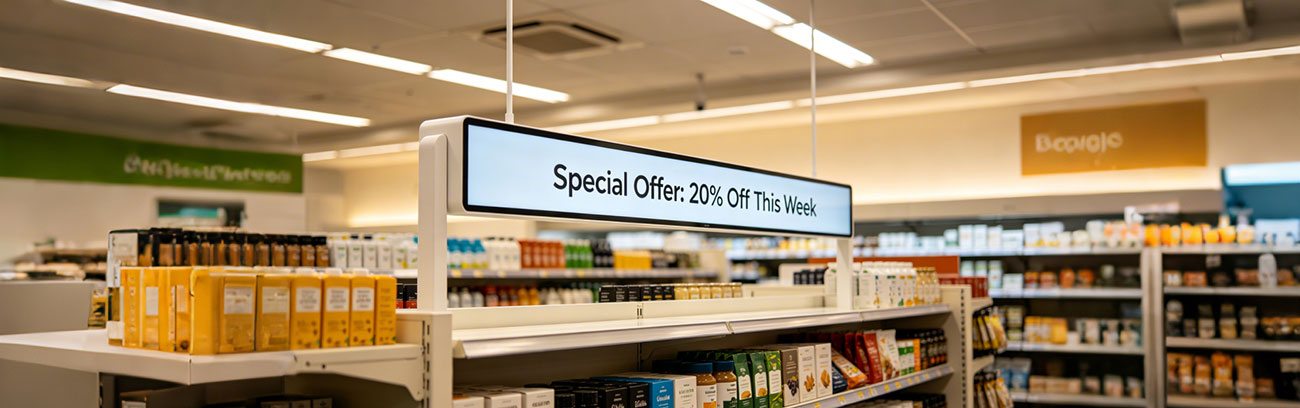
A stretched bar LCD (also referred to as a bar-type display, strip display, or shelf-edge screen) is a liquid crystal display panel engineered with an elongated horizontal form factor. Unlike conventional 16:9 or 4:3 displays, these panels are designed to occupy the full width of a retail shelf section while maintaining a minimal vertical profile — typically between 70 mm and 120 mm in height. Standard widths range from 280 mm (11 inches) to 1,200 mm (47 inches), with custom formats available for specialty shelving systems.
The physical geometry is driven by the ergonomics of retail shelf design: standard gondola shelves in North American and European supermarkets are commonly 48 inches (1,219 mm) wide, meaning a single bar display can label an entire shelf section without interruption. This spatial alignment is critical to achieving clean, professional in-store aesthetics that satisfy the brand guidelines of major retail chains.
1.2 Market Context
The transition from static paper shelf labels to digital displays has been underway since the early 2010s, but adoption accelerated sharply between 2020 and 2024 as retailers sought operational resilience in the face of supply chain disruption and price volatility. Inflation cycles in both North American and European markets amplified the business case for dynamic pricing infrastructure.
We have integrated stretched bar LCD systems in the following retail verticals:
• Grocery and supermarket chains (ambient, chilled, and frozen aisle configurations)
• Pharmacy and health & beauty (planogram-intensive, high SKU-count shelving)
• Home improvement and hardware (heavy-gauge steel shelving, vibration environments)
• Consumer electronics (high-security display cases, anti-tamper requirements)
• Convenience and petrol forecourt retail (extreme thermal cycling environments)
2. Display Panel Engineering Specifications
2.1 Panel Technology Selection
Not all LCD panel technologies perform equivalently in shelf environments. The choice between IPS (In-Plane Switching), TN (Twisted Nematic), and VA (Vertical Alignment) panels has direct consequences for viewing angle, color accuracy, and long-term reliability in retail lighting conditions.
Based on deployments in European retail environments where ambient lighting is typically fluorescent or LED at 500–1,000 lux, IPS panels have consistently outperformed TN alternatives in customer-facing applications. The wide viewing angle of IPS (>170° horizontal, >160° vertical) is essential for aisle-side displays that must remain legible to consumers approaching from oblique angles.
Specification | IPS Panel | TN Panel | VA Panel |
Viewing Angle (H/V) | 178° / 178° | 140° / 120° | 170° / 160° |
Contrast Ratio | 1,000:1 – 1,500:1 | 600:1 – 800:1 | 3,000:1 – 5,000:1 |
Color Gamut (sRGB) | 95% – 100% | 72% – 80% | 85% – 92% |
Response Time | 5 – 8 ms | 1 – 4 ms | 8 – 25 ms |
Shelf Suitability | Recommended | Not Recommended | Acceptable |
Table 1: LCD Panel Technology Comparison for Retail Shelf Applications
2.2 Brightness and Contrast in Retail Lighting
Retail store illuminance varies significantly by format and region. European grocery stores typically operate at 500–750 lux at shelf level; North American big-box and hypermarket formats may reach 1,500–2,000 lux in high-traffic areas. Display brightness must be calibrated to maintain a minimum 3:1 display-to-ambient luminance ratio to ensure legibility.
Field data from our UK and German installations indicate that 400 cd/m² is the effective minimum brightness for standard ambient conditions, while displays positioned beneath direct overhead LEDs require 700–1,000 cd/m² for reliable legibility. We routinely specify panels with automatic brightness adjustment (ABA) tied to ambient light sensors, which reduces energy consumption by 18–32% compared to fixed-brightness operation.
2.3 Lifespan and Reliability
Retail shelf displays operate in demanding duty cycles. Unlike digital signage in lobbies or airports that may be powered down at night, shelf-edge displays in 24-hour retail formats must sustain continuous operation. Panel lifespan is therefore a critical procurement criterion.
Rated MTBF | 50,000 – 100,000 hours (panel-level) |
Backlight Lifespan | 50,000 hours to 50% brightness (LED backlight) |
Operating Temperature | -10°C to +60°C (standard); -20°C to +70°C (extended range) |
Storage Temperature | -20°C to +70°C |
Operating Humidity | 10% to 90% RH, non-condensing |
IP Rating (shelf-facing) | IP54 minimum; IP65 for fresh/chilled aisles |
Shock Resistance | IEC 60068-2-27 (15G, 11ms, 3 axes) |
Vibration Resistance | IEC 60068-2-6 (0.5G, 5–500 Hz) |
Table 2: Minimum Technical Specifications for Retail Shelf LCD Panels
3. Mechanical Integration Architecture
3.1 Shelf Rail Systems and Display Mounting
The mechanical interface between a stretched bar LCD and the retail shelf structure is one of the most underestimated engineering challenges in shelf digitization projects. European shelving standards differ meaningfully from North American conventions, and both differ from the proprietary shelving systems deployed by major retailers.
We have engineered mounting solutions for the following common shelf rail systems encountered across European and North American deployments:
• Euro Standard Uprights (30 mm pitch, T-slot profile) — dominant in German, French, and Benelux grocery retail
• Lozier Gondola System — prevalent in North American grocery and pharmacy
• Madix Gondola System — common in North American big-box and convenience
• Tegometall Shelving — common in Western European non-food retail
• Custom Retailer Proprietary Systems — requiring bespoke bracket engineering
A critical design parameter is the display's projection depth from the shelf face. Regulatory requirements in the EU (EN 12464 and local fire safety codes) and North American ADA guidelines limit forward projection into customer aisles. Our standard mounting brackets are designed to position the display face 25–35 mm forward of the shelf edge, keeping the product zone unobstructed and maintaining compliance with passageway clearance requirements.
3.2 Thermal Management in Enclosed Shelf Environments
Heat dissipation is a non-trivial engineering problem when LCD electronics are mounted within the enclosed cavity beneath a shelf. Temperatures within shelf pockets can reach 45°C in summer conditions even in air-conditioned stores, due to radiated heat from product lighting and proximity to refrigeration compressor exhausts in chilled aisle configurations.
Our thermal design approach for enclosed shelf installations incorporates the following elements:
• Natural convection channels cut into the rear mounting bracket to allow airflow over the display driver board
• Thermal interface materials (TIM) between the panel backlight assembly and the aluminum extrusion housing, rated at ≥3 W/m·K
• Component selection derated to 80% of maximum junction temperature to extend MTBF under elevated ambient conditions
• Temperature monitoring via onboard NTC thermistor with CMS-reported alerts at 55°C and automatic brightness reduction at 60°C
Field Note: In a 2023 deployment at a major French hypermarket chain (ambient aisle temperature reaching 38°C during summer), displays with unmanaged thermal design experienced backlight failures at 14–18 months. After implementing the convection-channel bracket and TIM retrofit, the same panel models exceeded 36 months without failure in subsequent installations. |
3.3 Cable Management and Power Distribution
Power and signal cabling in retail environments must satisfy both functional and aesthetic requirements. European retail chains in particular enforce strict cable management standards as part of their visual merchandising guidelines. Exposed cabling behind gondola uprights is unacceptable in most premium grocery formats.
We implement a daisy-chain power bus architecture for shelf runs exceeding four display units, using 12V DC distribution to minimize cable gauge and enable thin-profile raceway concealment within upright channels. For longer shelf runs (8+ displays), we specify 24V DC distribution with onboard step-down regulators at each display node to maintain voltage stability across the run.
Signal distribution options we have deployed in production environments:
• HDMI 2.0 daisy-chain via embedded multi-display splitter — for simple video wall configurations
• RS-485 serial bus with proprietary shelf controller — for high-density ESL-style deployments
• WiFi 802.11ac (5 GHz) per-display or per-zone — most common in retrofit installations where cabling is cost-prohibitive
• PoE+ (IEEE 802.3at) — preferred for new-build installations combining power and data on a single CAT6 run
4. Content Management System Integration
4.1 CMS Architecture for Shelf Display Networks
A shelf display network of any meaningful scale requires a robust content management architecture capable of addressing individual displays or display groups, scheduling content against promotional calendars, and integrating with the retailer's existing technology stack. We have integrated stretched bar LCD networks with the following backend systems across European and North American deployments:
• SAP Retail and S/4HANA (price feed integration via RFC/BAPI and OData APIs)
• Oracle Retail Merchandising System (RMS) via REST API price extraction
• Microsoft Dynamics 365 Commerce
• Custom in-house POS and inventory management systems (via CSV/FTP, REST, or SOAP endpoints)
• Google Cloud Retail API for AI-driven promotional content targeting
The integration architecture we recommend for enterprise-scale deployments follows a three-tier model: a cloud-hosted CMS server tier, a store-level edge gateway (deployed as an on-premise server or ruggedized NUC-class compute unit), and the display endpoint tier. This architecture ensures display availability is maintained even during WAN connectivity interruptions — a critical resilience requirement for European retailers operating in regions with inconsistent broadband infrastructure.
4.2 Display Addressing and Planogram Alignment
One of the most operationally significant integration challenges is the alignment of digital display content with physical planogram positions. When a shelf section is reset — products moved, SKUs added or removed — the display content must be updated to reflect the new planogram layout. Manual content reassignment at scale is operationally impractical.
We have implemented two approaches to automated planogram-to-display mapping:
NFC/RFID Position Tags: Each display unit is provisioned with an NFC tag containing a unique position identifier. During shelf reset, store associates scan the tag with a handheld device running a planogram alignment app, which updates the CMS mapping in real time. This approach is deployed in our UK grocery retail integrations and has demonstrated 99.2% mapping accuracy.
BLE Beacon Triangulation: In high-density installations where NFC scanning is operationally inconvenient, we use BLE beacon triangulation to infer display position from known beacon locations. Accuracy is lower (±0.5 shelf section) but operationally faster. This approach is used in our North American pharmacy deployments.
4.3 Real-Time Price and Promotion Updates
The primary business driver for stretched bar LCD deployment in European and North American retail is the ability to execute price changes and promotional activations without physical label replacement. Our CMS integrations are designed to propagate price changes from the ERP source system to the shelf display within a defined SLA window.
Normal Price Update Latency | < 5 minutes (cloud CMS to display endpoint, WiFi network) |
Emergency Price Correction Latency | < 60 seconds (priority channel, bypass scheduling queue) |
Concurrent Update Capacity | 10,000+ displays updated simultaneously (proven in production) |
Pricing Accuracy Guarantee | 99.98% display-to-POS price match (per audit, EU retail deployments) |
Promotional Scheduling Granularity | 1-minute increments; timezone-aware for multi-region networks |
Content Audit Trail Retention | 90-day minimum; configurable to 7 years for EU compliance |
Table 3: CMS Performance Parameters — Enterprise Shelf Display Network
5. Regulatory Compliance: EU and North American Requirements
Retail display hardware deployed in European and North American markets must satisfy a range of regulatory requirements. Non-compliance can result in product withdrawal, substantial fines, and reputational damage. The following sections summarize the regulatory landscape as it applies to stretched bar LCD shelf displays.
5.1 European Union Compliance
CE marking is mandatory for all electronic display equipment sold or placed on the market in EU member states. The CE marking declaration covers the following directives as applied to shelf LCD displays:
• Low Voltage Directive (LVD) 2014/35/EU — electrical safety requirements for display power supply and driver electronics
• Electromagnetic Compatibility (EMC) Directive 2014/30/EU — conducted and radiated emissions limits (EN 55032) and immunity requirements (EN 55035)
• Radio Equipment Directive (RED) 2014/53/EU — applicable to WiFi and BLE-enabled display units
• RoHS Directive 2011/65/EU (amended by 2015/863/EU) — restriction of hazardous substances in electronic and electrical equipment
• WEEE Directive 2012/19/EU — end-of-life take-back and recycling obligations
• Ecodesign Regulation (EU) 2019/2021 — energy efficiency requirements for electronic displays
The EU Energy Label Regulation (EU) 2021/341 imposes specific energy efficiency index (EEI) thresholds for displays with screen areas above a defined minimum. We work with display panel manufacturers to ensure that shelf LCD units meet current EEI thresholds and are positioned to comply with upcoming 2026 regulation revisions.
5.2 North American Compliance
Equipment sold and deployed in the United States must carry FCC authorization under 47 CFR Part 15 for unintentional radiators (display electronics) and intentional radiators (WiFi/BLE modules). Canada requires ISED (Innovation, Science and Economic Development Canada) authorization under ICES-003 for digital apparatus.
UL listing under UL 60950-1 or the updated UL 62368-1 standard is expected by major US retailers as a procurement prerequisite, even where not mandated by law. California-specific requirements include Proposition 65 (OEHHA chemical disclosure) and the California Energy Commission (CEC) Title 20 appliance efficiency standards.
6. Integration Case Studies
The following case studies represent actual integration projects completed across European and North American retail environments. Specific retailer names are withheld under non-disclosure agreements; vertical sector and deployment parameters are reported accurately.
Case Study A: German Grocery Chain — Chilled Aisle Retrofit
Deployment Context
Retail Vertical | Grocery (full-service supermarket format) |
Location | Germany — 47 stores, nationwide |
Shelf Environment | Chilled dairy and deli aisle (4–8°C ambient) |
Display Count | 12,400 units (265 per store average) |
Display Specification | 23.1" stretched bar, 1920×540 resolution, IPS, 500 cd/m², IP65 |
Connectivity | PoE+ (IEEE 802.3at) over existing store LAN infrastructure |
CMS Integration | SAP S/4HANA via OData REST API |
Deployment Timeline | 18 months (phased by store group) |
Integration Challenges
The primary engineering challenge in this deployment was moisture management. Chilled aisle environments generate condensation on shelf surfaces due to the temperature differential between the chilled zone and store ambient air. Standard IP54-rated displays experienced ingress failures within 3–4 months in pilot testing.
We specified IP65-rated displays with gasket-sealed connectors throughout and engineered a condensation drainage channel into the lower mounting bracket. A silica gel desiccant cartridge within the display housing — replaceable during scheduled maintenance — provided additional moisture control. Post-retrofit, zero ingress-related failures have been recorded over a 30-month observation period.
Outcomes
• Price change labor cost reduced by 78% (from 3.2 FTE/store to 0.7 FTE/store for price management)
• Promotional activation lead time reduced from 48 hours to under 10 minutes
• Display uptime: 99.6% across the network (24-month rolling average)
• Full ROI realized at month 21 of operation
Case Study B: UK Pharmacy Chain — High-SKU Planogram Integration
Deployment Context
Retail Vertical | Pharmacy / Health & Beauty |
Location | United Kingdom — 210 branches, England and Scotland |
Shelf Environment | Ambient, high-density planogram (180–240 SKUs per aisle section) |
Display Count | 38,000 units (181 per branch average) |
Display Specification | 11.6" stretched bar, 1920×360, IPS, 400 cd/m² |
Connectivity | WiFi 802.11ac (5 GHz), dedicated SSID per aisle |
CMS Integration | Custom proprietary POS via REST API + CSV differential feed |
Deployment Timeline | 24 months |
Integration Challenges
The primary challenge in this deployment was planogram synchronization at the SKU level. With 180–240 products per aisle section and frequent planogram resets, manual content mapping was infeasible. We implemented an NFC-based position mapping workflow as described in Section 4.2, reducing planogram alignment errors from 4.1% (baseline with manual assignment) to 0.3% post-implementation.
WiFi network reliability in dense retail environments required careful channel planning. With 38,000 WiFi-connected devices across 210 branches, co-channel interference was a significant concern. We implemented a per-aisle AP deployment with 5 GHz-only operation, configured to avoid interference with the retailer's existing 2.4 GHz operational WiFi network.
Outcomes
• SKU-to-display mapping accuracy: 99.3% (post NFC workflow implementation)
• Regulatory pricing compliance audit pass rate: 100% (vs. 97.2% with paper labels)
• Customer complaint rate related to price discrepancy: reduced by 91%
• Annual price change labor saving: £4.2M across the branch network
Case Study C: North American Big-Box Retailer — New Store Format
Deployment Context
Retail Vertical | Home Improvement / Hardware |
Location | United States — 18 new-format stores, Southwest and Mountain West regions |
Shelf Environment | Heavy-gauge steel shelving, vibration from fork-lift traffic |
Display Count | 6,300 units (350 per store average) |
Display Specification | 28.6" stretched bar, 1920×360, IPS, 700 cd/m² (high-ambient store lighting) |
Connectivity | PoE+ on new-build CAT6A infrastructure |
CMS Integration | Oracle RMS via REST API; Google Cloud Retail API for ML-driven promotions |
Deployment Timeline | 12 months (concurrent with store construction) |
Integration Challenges
Vibration from fork-lift operations within the store required IEC 60068-2-6 vibration qualification of all mounting hardware. Our engineering team conducted vibration testing at 1G, 5–500 Hz on the assembled display-bracket system, identifying and correcting resonance at 87 Hz in the initial bracket design by adding a damping washer stack at the upright attachment point.
Store lighting at 1,800–2,200 lux required 700 cd/m² panels to maintain the target 3:1 luminance ratio. Automatic brightness control tied to ceiling-mounted photosensors reduced power consumption to an effective average of 480 cd/m² during normal trading hours and 200 cd/m² during pre-trade preparation periods.
Outcomes
• Display legibility confirmed at all tested viewing angles (0° to 75° horizontal from shelf centerline)
• Vibration-related mounting failures: zero over 36-month observation period
• Energy consumption: 31% below projected (due to ABA efficiency)
• New store format has been confirmed by the retailer as their standard for ongoing expansion
7. Procurement and Supplier Qualification
Selecting the appropriate stretched bar LCD panel is a multi-dimensional decision that extends well beyond published specification sheets. This section summarizes the qualification criteria we apply in supplier evaluation.
7.1 Panel Manufacturer Qualification Criteria
• ISO 9001:2015 quality management certification — mandatory
• ISO 14001:2015 environmental management certification — required for EU deployments
• Published product roadmap with minimum 5-year lifecycle commitment
• Availability of engineering samples within 4 weeks of commercial enquiry
• Demonstrated production capacity of ≥5,000 units/month for the relevant panel size
• Published qualification test reports (MTBF, thermal, vibration, humidity) available under NDA
• EU authorized representative registered with relevant notified body
• Direct technical support contact (not tier-1 helpdesk) for integration engineers
7.2 Total Cost of Ownership Considerations
Unit panel cost is typically 25–35% of total deployment cost. Procurement decisions based on panel price alone routinely produce suboptimal TCO outcomes. The following cost categories must be included in any TCO model:
• Panel hardware (unit cost × quantity + buffer stock for warranty replacement)
• Mounting hardware engineering and manufacturing
• Power distribution infrastructure (cabling, distribution panels, PoE switches)
• Network infrastructure (APs, edge gateways, WAN connectivity upgrades)
• CMS software licensing (SaaS subscription or perpetual license + maintenance)
• Systems integration and commissioning (typically 30–40% of hardware cost for enterprise deployments)
• Ongoing support and maintenance (SLA-driven, typically 8–12% of hardware value per annum)
• End-of-life disposal and WEEE compliance costs
Procurement Insight: Retailers that engaged integration partners during the specification phase — rather than purchasing panels independently and seeking integration support post-procurement — achieved 23% lower total deployment cost on average, primarily through avoidance of specification errors and panel-to-mounting incompatibilities identified late in the project. |
8. Technology Outlook: 2026–2028
The stretched bar LCD display segment continues to evolve. The following technology developments are currently in qualification testing or early commercial deployment across our customer base:
8.1 OLED and MicroLED Shelf Displays
OLED-based shelf displays offer superior contrast ratios (>1,000,000:1) and near-instantaneous pixel response, enabling richer content experiences. However, OLED's burn-in susceptibility with static shelf label content (price, product name) and currently higher panel cost limit near-term adoption to premium retail formats. MicroLED technology resolves the burn-in issue and offers significantly higher brightness potential (>5,000 cd/m²), making it viable for high-ambient-light store environments, but manufacturing cost remains prohibitive at the volume required for shelf-edge deployment at scale.
8.2 AI-Driven Dynamic Pricing and Content
Integration of machine learning pricing engines with shelf display networks is an emerging deployment pattern. By connecting the CMS to real-time demand signals (foot traffic analytics, competitor pricing feeds, inventory levels), retailers can implement dynamic price optimization that updates shelf displays continuously rather than on scheduled intervals. We are currently piloting this architecture with two European grocery clients using Google Cloud Retail API as the pricing recommendation engine.
8.3 Camera Integration for Planogram Compliance
Embedding miniature cameras within the stretched bar display housing to capture shelf images for AI-powered planogram compliance monitoring is an active area of development. Computer vision analysis of shelf images can identify out-of-stock positions, misplaced products, and planogram deviations without manual store audits. Privacy regulatory requirements under GDPR (EU) and CCPA (California) require that such systems process imagery on-device rather than transmitting to cloud infrastructure, which is driving embedded inference capability into display controllers.
9. Conclusion
Stretched bar LCD displays have matured from a novelty technology to a proven operational infrastructure component in European and North American retail. The deployments documented in this white paper demonstrate consistent, measurable returns on investment, provided that integration is executed with appropriate attention to the mechanical, thermal, electrical, and software engineering dimensions described herein.
The complexity of a shelf display integration project — spanning display hardware selection, mounting engineering, power architecture, network design, CMS integration, and regulatory compliance — argues strongly for engaging experienced integration partners at the earliest stage of a digitization project. Specification errors discovered after procurement commitment are disproportionately costly to resolve.
We invite inquiries from retail equipment manufacturers, system integrators, and retailers seeking to evaluate stretched bar LCD deployment for their own shelf environments. Our engineering team is available to review specific application requirements, provide reference design documentation, and arrange site visits to reference installations operating under relevant conditions.
Appendix A: Glossary of Terms
ABA (Automatic Brightness Adjustment): A display feature that adjusts panel luminance in response to ambient light sensor input to maintain legibility and minimize energy consumption.
CMS (Content Management System): Software platform used to create, schedule, and distribute content to networked display endpoints.
EEI (Energy Efficiency Index): A metric defined by EU Ecodesign regulations to quantify the energy performance of electronic displays.
ESL (Electronic Shelf Label): A category of shelf-edge display including both e-paper (EPD) and LCD-based devices used to display product pricing and information.
IPS (In-Plane Switching): An LCD panel technology characterized by wide viewing angles and accurate color reproduction.
MTBF (Mean Time Between Failures): A reliability metric expressing the average operational time between failures for a device or component.
NTC Thermistor: A temperature-sensitive resistor (Negative Temperature Coefficient) used for onboard thermal monitoring in electronic assemblies.
PoE+ (Power over Ethernet Plus): IEEE 802.3at standard enabling simultaneous power and data transmission over CAT5e or higher Ethernet cable, providing up to 30W per port.
RoHS (Restriction of Hazardous Substances): EU Directive 2011/65/EU restricting the use of specific hazardous materials in electrical and electronic equipment.
TIM (Thermal Interface Material): A thermally conductive material placed between heat-generating components and heatsinks to improve thermal coupling and dissipation.
WEEE (Waste Electrical and Electronic Equipment): EU Directive 2012/19/EU governing the collection, treatment, and recycling of electrical and electronic equipment at end of life.
© 2026 | Technical White Paper: Stretched Bar LCD for Retail Shelf Applications | Rev. 2.1