HITULCD
Stretched Bar Display Division
TECHNICAL WHITE PAPER
Stretched Bar LCD Displays in Indoor Passenger Information Systems
Deployment Architecture, Performance Engineering & Market Differentiation
Document No. | HITULCD-WP-PIS-2026-001 |
Version | V2.1 |
Issue Date | 2026 |
Confidentiality | Client Sharing Edition |
Department | Product Technology Center |
Applicable Markets | Rail Transit / Airport / High-Speed Rail / Commercial |
Executive Summary
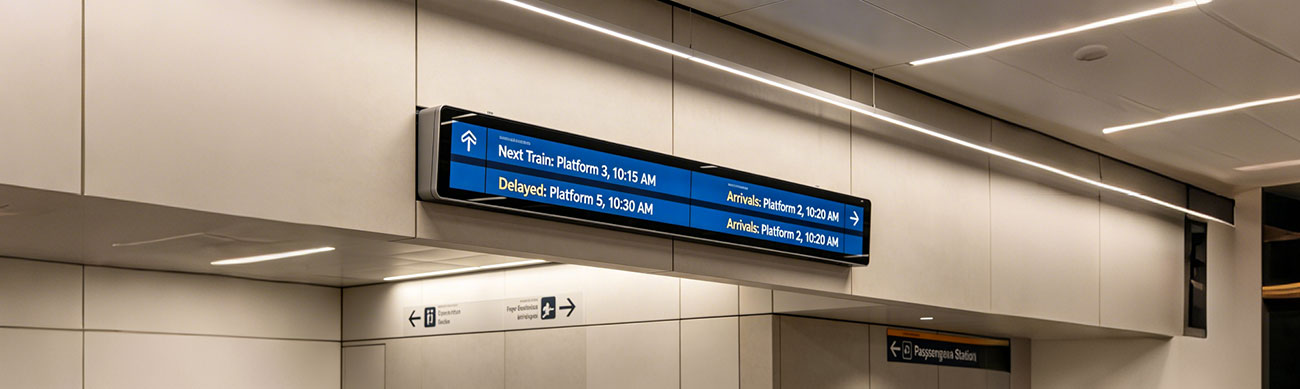
The global expansion of urban rail transit, international airports, high-speed rail terminals, and large-scale commercial complexes has imposed unprecedented hardware demands on Passenger Information Systems (PIS). Conventional 16:9 and 4:3 LCD panels — engineered for desktop computing and consumer entertainment — are structurally mismatched to the elongated installation spaces inherent to public transport infrastructure: door headers, platform columns, overhead luggage racks, and corridor fascias.
HITULCD Stretched Bar LCD Displays address this mismatch at the hardware level. With native aspect ratios spanning 7:1 to 32:1, proprietary signal-processing architecture, and industrial-grade environmental resilience, HITULCD products deliver a physically congruent display solution for indoor PIS environments. This white paper presents a rigorous analysis of HITULCD core technology advantages, typical deployment scenarios across six indoor PIS sub-categories, a fourteen-dimension competitive benchmarking matrix against mainstream display alternatives, complete system integration specifications, and validated field case studies — equipping systems integrators, procurement engineers, and project planners with the evidence base required for confident sourcing decisions.
Core Value Propositions Native Form-Factor Fit — No masking, no splicing; geometry-matched to headers, columns, and fascia channels High-Ambient Brightness — 700–1500 cd/m² sustains legibility under indoor overhead lighting Industrial Reliability — MTBF ≥ 50,000 hours; designed for 7×24 uninterrupted operation Multi-Protocol Integration — Native RS485 / UDP / HTTP / MQTT support across all major PIS middleware stacks Full-Lifecycle TCO Advantage — Low-power design and modular serviceability reduce operational cost by 30%+ |
Chapter 1 Market Background & Industry Pain Points
1.1 Evolution of Display Hardware in Passenger Information Systems
PIS display hardware has progressed through three generational transitions: mechanical split-flap boards, LED dot-matrix panels, and liquid crystal displays. LCD technology's superior color fidelity, dynamic multimedia capability, and lower lifecycle maintenance costs have made it the dominant specification for both new-build and retrofit projects since the mid-2010s. However, the 16:9 and 4:3 aspect ratios standardized by the consumer electronics industry were never optimized for the spatial constraints of public transport infrastructure.
As daily ridership at major urban metro networks surpasses one million passengers and international airports process tens of millions of annual travelers, passenger expectations for real-time information accuracy and visibility have risen sharply. Concurrently, transport architects and interior designers increasingly demand that display hardware integrate seamlessly into station aesthetics — a standard that legacy "screen-stacking" approaches fail to meet.
1.2 Structural Deficiencies of Standard Rectangular Screens in PIS Environments
Based on HITULCD engineering surveys across more than 200 rail transit stations internationally and accumulated project data, five systemic pain points recur consistently:
▪ Space Inefficiency: When a standard 16:9 display is installed in a door header, less than 40% of the panel area carries active information; the remainder is filled with background graphics or dead black — wasting expensive display real estate and degrading passenger visual-capture rates.
▪ Legibility Disruption at Splice Seams: Multi-screen tiling introduces physical gaps that interrupt scrolling timetables and running text, creating readability breaks at precisely the moments passengers need continuous information flow.
▪ High Installation Complexity: Standard panels retrofitted with custom brackets, masking frames, and cable conduits increase per-node installation labor by 2–4x, with a proportional increase in total installed cost.
▪ Power Redundancy: Full-backlight drive across a standard panel whose effective display area represents a fraction of panel surface area generates avoidable power consumption; across a large terminal this excess load can accumulate to tens of kilowatts.
▪ Extended Maintenance Downtime: Large standard displays in confined spaces require extended track-access or platform-exclusion windows for each service intervention — a critical operational cost in high-frequency transit environments.
Chapter 2 HITULCD Stretched Bar Display Product Architecture
2.1 Product Definition & Form-Factor Specifications
A stretched bar LCD is defined as an industrial-grade liquid crystal panel with an aspect ratio of 4:1 or greater. The HITULCD product line spans the full commercial spectrum from 7:1 to 32:1. Unlike consumer-panel elongation approaches, HITULCD employs a dedicated industrial mother-glass cutting process with custom backlight assemblies, ensuring brightness uniformity (Uniformity ≥ 85%) and color temperature consistency (Delta E < 3) across the full panel area — meeting commercial display standards throughout.
Model Series | Aspect Ratio | Typical Resolution | Physical Size (inches) | Primary PIS Application |
SB-700 Series | 7:1 | 1680×240 | 29"–35" | Small door-header display |
SB-1000 Series | 10:1 | 1920×192 / 2560×256 | 32"–40" | Platform train information |
SB-1600 Series | 16:1 | 1920×120 / 3840×240 | 40"–55" | Corridor wayfinding |
SB-2300 Series | 23:1 | 2560×112 / 4096×178 | 55"–72" | Concourse advertising & info |
SB-3200 Series | 32:1 | 3840×120 / 5120×160 | 72"–100" | Large waiting hall fascia |
2.2 Core Technical Specifications
2.2.1 Optical Performance
HITULCD optical parameters are calibrated specifically for the complex ambient-light conditions of indoor public spaces:
Optical Parameter | Standard (Indoor Standard) | Enhanced (Indoor Enhanced) |
Brightness | 700 cd/m² | 1000 cd/m² |
Contrast Ratio | ≥ 1200:1 | ≥ 1500:1 |
Viewing Angle (H/V) | 178° / 178° | 178° / 178° |
Color Gamut | 72% NTSC | 85% NTSC (DCI-P3 90%) |
Backlight Lifetime | ≥ 50,000 hours | ≥ 60,000 hours |
Brightness Uniformity | ≥ 82% | ≥ 88% |
Color Temperature | 6500K ± 300K | 6500K ± 200K (adjustable) |
2.2.2 Signal & Interface Specifications
Interface Type | Specification | Notes |
Video Input | HDMI 2.0 / DisplayPort 1.2 | Supports 4K@60Hz signal input |
Network Interface | RJ45 100M/1000M Ethernet | UDP/TCP/HTTP content push |
Serial Interface | RS232 / RS485 (optional) | Legacy PIS control system compatibility |
Wireless (optional) | Wi-Fi 802.11ac / 4G LTE | Cable-free retrofit deployments |
Internal Storage | eMMC 16GB / 32GB (optional) | Local content cache & offline playback |
Control Protocols | HTTP REST / MQTT / UDP | Compatible with major PIS middleware platforms |
2.2.3 Environmental & Reliability Specifications
Environmental Parameter | Specification | Test Standard |
Operating Temperature | 0°C ~ +50°C | IEC 60068-2 |
Storage Temperature | -20°C ~ +60°C | IEC 60068-2 |
Relative Humidity | 10% ~ 90% RH (non-condensing) | IEC 60068-2-78 |
Ingress Protection | IP40 (standard) / IP54 (optional) | IEC 60529 |
Vibration Resistance | 10~200Hz, 0.5g | IEC 60068-2-6 |
MTBF | ≥ 50,000 hours | Telcordia SR-332 |
Certifications | CE / FCC / RoHS / CB | — |
Chapter 3 Indoor PIS Deployment Scenarios
3.1 Scenario Overview
Indoor PIS display requirements differ fundamentally from roadside, outdoor-advertising, and general commercial applications. Passenger movement paths within enclosed transport spaces are highly predictable; information needs are strongly time-sequential (train arrival/departure times, transfer wayfinding, emergency evacuation instructions); and installation positions are invariably constrained by existing building structure. The physical geometry of HITULCD stretched bar displays aligns inherently with these requirements. The following sections provide engineering-level analysis across six canonical indoor PIS sub-scenarios.
3.2 Platform Door-Header Display Systems
3.2.1 Scenario Characteristics
The door-header zone above platform screen doors (PSD) or safety barriers is the most natural visual dwell point for waiting passengers, and the highest information-density PIS location in the station. Header heights typically range from 150mm to 300mm; widths correspond to door panel dimensions, standardly 1,200mm–2,000mm.
3.2.2 HITULCD Solution
▪ Recommended Models: SB-1000-32 / SB-1000-40 (10:1 aspect ratio, 1920×192 resolution)
▪ Installation Method: Front-access flush-mount, panel face coplanar with header surface; compliant with UTO (Unattended Train Operation) maintenance access standards
▪ Content Capability: Simultaneous display of train destination, next departure time, current dwell position, and emergency text alert across four independent content zones
▪ Synchronization Precision: UDP multicast frame-sync across all platform screens achieves ≤16ms inter-screen latency; scrolling text is visually seamless across all units
▪ EMC Shielding: All-metal rear enclosure; EMC performance compliant with EN 50121-4 Railway Applications Electromagnetic Compatibility standard
3.3 Concourse Wayfinding Display Systems
3.3.1 Scenario Characteristics
The station concourse is the primary passenger distribution node for ingress, egress, and interchange. Columns, fare gate tops, and overhead channel fascias all require wayfinding display hardware. This scenario demands broad viewing-distance tolerance (1m–8m), high installation-height flexibility, and sub-second content switching latency.
3.3.2 HITULCD Solution
▪ Column Wrap: SB-700 series (7:1) installed on all four column faces provides 360° information coverage with no visual dead zones
▪ Channel Overhead: SB-1600 series (16:1) spanning full channel width delivers unified exit/transfer directional guidance
▪ Fare Gate Top: SB-700-29 (29 inches) embedded in gate top frame displays ticketing status and congestion-level indicators
▪ Zone-Based Content: Single display body supports up to three independently managed content zones simultaneously
3.4 On-Board Train Carriage Deployment
3.4.1 Scenario Characteristics
Next-generation metro and intercity rolling stock specifications require in-carriage dynamic route maps and multimedia content systems. Available installation space is severely constrained: above-door header beams measure 80mm–200mm in height; below-luggage-rack clearance is typically 100mm–180mm. Both locations place screens within 1.0–1.5 meters of seated passengers, making pixel density and even luminance critical to readability.
3.4.2 HITULCD Solution
▪ Above-Door Header Beam: SB-1000-32, overall depth <25mm; meets rolling stock clearance gauge requirements
▪ Below-Luggage-Rack: SB-700-29 low-power variant (≤8W); accepts DC 24V/36V vehicle power input
▪ Dynamic Route Map Engine: On-board vector route map renderer receives real-time ATS (Automatic Train Supervision) position signals and highlights the current station dynamically
▪ Multilingual Auto-Switch: Supports 8 language profiles (English, Mandarin, Japanese, Korean, and others) with automatic switching for international hub deployments
▪ Rolling Stock Certification: Compliant with EN 45545-2 Railway Vehicle Fire Protection; flame-retardancy grade HL2
3.5 Airport Gate Information Display Systems
3.5.1 Scenario Characteristics
Airport gate PIS requirements are highly dynamic: a single gate may service dozens of different flights per day, necessitating second-level content transitions between flights. Systems must interface with airline-standard information formats (IATA CUTE/CUSS compatible). Gate podium header heights of 200mm–400mm represent ideal native installation positions for stretched bar displays, eliminating all masking requirements.
3.5.2 HITULCD Solution
▪ Recommended Models: SB-1000-40 / SB-1600-50 (1920×192 @ 40"; 1920×120 @ 50")
▪ FIDS Templates: Pre-configured Flight Information Display System standard templates with DCS (Departure Control System) API integration
▪ Adaptive Brightness: Ambient light sensor auto-adjusts backlight intensity in response to terminal lighting conditions; energy savings up to 35%
▪ Dual-Hot-Standby: Primary/backup media player hot-failover with recovery time ≤3 seconds; meets airport critical-information-system 99.95% availability requirement
3.6 Commercial Complex Information & Wayfinding Systems
3.6.1 Scenario Characteristics
Large-scale commercial complexes (shopping centers, exhibition halls, sports arenas) require indoor digital signage that serves dual functions: operational wayfinding and brand marketing. Installation locations include elevator lobby fascias, escalator side panels, and corridor ceiling soffits. Compared to transport hubs, commercial environments place greater emphasis on color fidelity and creative content compatibility.
3.6.2 HITULCD Solution
▪ Recommended Models: SB-1600 Enhanced (85% NTSC wide color gamut) to satisfy brand visual identity specifications
▪ CMS Integration: Standard SMIL / HTML5 content format; compatible with major digital signage CMS platforms (Scala, Signagelive, BrightSign)
▪ Split-Screen Advertising: 1–4 independent content zones support simultaneous wayfinding and advertising monetization within a single display body
▪ Interactive Extension: Optional PCAP multi-touch overlay supports interactive wayfinding kiosk functionality
3.7 High-Speed Rail Terminal Deployments
3.7.1 Scenario Characteristics
High-speed rail passenger terminals present three architecturally distinct PIS deployment tiers: the waiting hall, the ticket-gate array, and platform canopy structures. Large passenger volumes and relatively extended dwell times demand comprehensive information completeness, while systems must maintain live data synchronization with national rail scheduling platforms.
3.7.2 HITULCD Solution
▪ Waiting Hall Ceiling Beams: SB-2300-65 (23:1, 2560×112) displays hall-wide seating zone guidance across the full beam span
▪ Ticket Gate Array: SB-700-32 embedded in gate top frame shows gate status and waiting area directional indicators
▪ Platform Canopy Columns: SB-1000-40 IP54-rated version; withstands elevated humidity and moisture ingress in semi-exposed platform environments
▪ TDCS Interface: Standard OPC-UA interface connects to Railway Train Dispatching Computer Systems for real-time train movement information push
Chapter 4 Competitive Benchmarking: HITULCD vs. Market Alternatives
4.1 Competitive Landscape Definition
This chapter presents an objective fourteen-dimension comparative analysis of HITULCD stretched bar displays against four mainstream market alternatives: standard commercial LCD monitors, LED dot-matrix/COB panels, e-paper (electronic ink) displays, and generic-brand bar displays (represented by commonly available industrial portrait/bar screens). Evaluation dimensions span form-factor fit, display performance, system integration, reliability, and total cost of ownership.
4.2 Comprehensive Performance Benchmarking Matrix
Evaluation Dimension | HITULCD Stretched Bar | Standard Commercial LCD | LED Dot-Matrix / COB | E-Paper Display | Generic-Brand Bar Screen |
Aspect Ratio Range | 7:1 ~ 32:1 (native) | 16:9 / 4:3 (fixed) | Customizable (high cost) | 1:1 ~ 4:1 typical | 4:1 ~ 16:1 |
Indoor Brightness | 700–1500 cd/m² | 250–400 cd/m² | 2000+ cd/m² (high power) | Reflective (no backlight) | 400–800 cd/m² |
Color Fidelity | 72–85% NTSC | 72% NTSC | Limited by pixel pitch | 16 grayscale levels | 72% NTSC |
Video / Dynamic Content | 60Hz full video support | 60Hz full video support | Driver-card dependent | Not supported | 60Hz video support |
Resolution (PPI) | High (≥60 PPI) | High (≥80 PPI) | Low (pitch ≥1.2mm) | Medium (200 DPI) | Medium (40–60 PPI) |
Installation Space Fit | Native fit to fascia geometry | Requires custom masking brackets | Requires custom framework | Compatible, limited content | Basic compatibility |
Typical Power Draw | 8–35W (size-dependent) | 30–80W (size-dependent) | 50–200W (pixel-count dependent) | ≤1W (brief at refresh) | 15–50W |
PIS Protocol Support | RS485/UDP/MQTT native | Requires external media player | Proprietary controller protocols | Limited (vendor-specific) | Partial support |
MTBF | ≥50,000 hours | 30,000–40,000 hours | ≥100,000 hours (LED die) | ≥10 years (static) | 30,000–50,000 hours |
Operating Temp. Range | 0~50°C | 0~40°C (consumer grade) | -20~60°C | -20~70°C | 0~50°C |
Rail Transit Certification | EN 50121-4, EN 45545-2 | Typically absent | Partial | Typically absent | Rarely held |
Serviceability | Front-access, modular | Typically rear-access only | LED module swap-out | Near-zero maintenance | Vendor-dependent |
Unit Acquisition Cost | Mid-range (best TCO) | Low (high total cost) | High | Low–Mid | Low–Mid |
Technical Support Depth | Full-stack + custom dev | Limited | Hardware-only | Limited | Limited |
4.3 Key Differentiators: In-Depth Analysis
4.3.1 Native Form-Factor Integrity: Zero-Compromise Physical Fit
This is the most fundamental differentiator between HITULCD products and standard commercial LCD panels. Fitting a standard 16:9 display into a 200mm door header necessitates masking or letterboxing that reduces effective display area by more than 60%, while the added masking frame increases structural depth and degrades architectural finish quality. HITULCD panels are dimensioned from first principles for elongated spaces: resolutions such as 1920×192 concentrate every pixel resource within the active display area. There is no physical space waste.
4.3.2 HITULCD vs. LED Dot-Matrix Panels: Fundamental Distinctions
LED dot-matrix and small-pitch COB panels have clear advantages in outdoor large-format and ultra-high-brightness applications, but carry inherent limitations in indoor close-proximity PIS environments. Pixel pitches of 1.2mm or greater produce visible grain at the 0.5–1.5m viewing distances typical of in-carriage installations, materially impairing text legibility. RGB direct-emission point sources generate significant glare and light pollution in relatively dim indoor environments. Control card communication protocols are typically proprietary, imposing high PIS integration overhead. HITULCD's LCD edge-lit diffusion technology produces a uniform planar light source with demonstrably superior text readability at 0.5–3.0m viewing distances.
4.3.3 HITULCD vs. Generic-Brand Bar Screens: The Depth Differential
Several general-purpose industrial display manufacturers offer bar-format products, but HITULCD's differentiation operates at three distinct levels. First, industry-specific certification: HITULCD products carry full EN 50121-4 Railway Applications EMC certification; generic bar screens typically hold only CE/FCC consumer-grade approvals. Second, integration capability: HITULCD provides a complete SDK with PIS protocol stacks and reference architectures, substantially reducing systems-integrator secondary development effort. Third, engineering support depth: HITULCD field engineering teams carry full-stack competency from display hardware through signal processing to content management platforms, enabling turnkey project delivery — a capability absent from hardware-only generic screen suppliers.
4.4 Five-Year Total Cost of Ownership (TCO) Analysis
Acquisition price is not a sufficient basis for display hardware evaluation. Based on HITULCD project data from a representative mid-size metro station (8 platforms, 40 display nodes), the following 5-year TCO comparison illustrates the full economic picture:
Cost Component | Standard LCD Tiled Solution | HITULCD Stretched Bar Solution | Variance |
Hardware Acquisition | ¥ 480,000 | ¥ 360,000 | Save 25% |
Custom Brackets & Installation | ¥ 220,000 | ¥ 80,000 | Save 64% |
Systems Integration & Development | ¥ 150,000 | ¥ 60,000 | Save 60% |
5-Year Electricity (CNY 0.8/kWh) | ¥ 126,000 | ¥ 52,000 | Save 59% |
5-Year Maintenance & Replacement | ¥ 95,000 | ¥ 30,000 | Save 68% |
Total 5-Year TCO | ¥ 1,071,000 | ¥ 582,000 | Total saving 46% |
Chapter 5 System Integration Technical Specifications
5.1 Network Architecture & Content Distribution
HITULCD indoor PIS solutions support three network topology modes, selectable by station scale and existing infrastructure:
▪ Centralized Mode: All display endpoints connect via Ethernet to a central content management server. Recommended for new-build projects with well-structured station control room networking.
▪ Distributed Mode: Zone controllers deployed per display area distribute content downstream via UDP multicast. Suited to large hubs or bandwidth-constrained network environments.
▪ Hybrid Mode: Critical information (emergency evacuation instructions) is hardcast via RS485 bus for guaranteed delivery; non-critical content distributed via IP network. Satisfies Railway Safety Integrity Level SIL2 requirements for critical information dissemination.
5.2 Content Format & Protocol Specifications
Protocol / Format | Function | Notes |
MQTT v3.1.1 / v5.0 | Real-time train information push | QoS 1/2; TLS encryption supported |
HTTP REST API | Content management & status query | OpenAPI 3.0 documentation included with SDK |
UDP Multicast | Multi-screen frame synchronization | Inter-screen sync precision ≤16ms |
RS485 / Modbus RTU | Emergency broadcast & status monitoring | Up to 128 devices per bus |
HTML5 / CSS3 | Dynamic content templates | Canvas / WebGL hardware acceleration supported |
XML (SIRI / NeTEx) | Public transport information standard format | Compliant with EU PIS interoperability standards |
5.3 Installation Engineering Requirements
▪ Conduit Pre-installation: Specify Ø25mm conduit pre-installation during civil works phase; route dedicated power cable (≥2.5mm²) and Cat6A data cable
▪ Earthing: Display metal enclosures must be reliably earthed; earth resistance ≤4Ω to prevent electrostatic accumulation and EMI coupling
▪ Thermal Clearance: Recessed-mount installations must provide ≥10mm thermal clearance on all four panel edges; top-surface ventilation path must remain unobstructed
▪ Front-Access Maintenance Space: Front-access models require ≥300mm clear space in front of the panel face post-installation (per IEC 61082 maintenance access requirements)
▪ Anti-Vibration Mounting: On-board rolling stock applications use anti-vibration rubber isolation mounts; isolation efficiency ≥70% in the 5–50Hz frequency band
5.4 Power Design Specifications
▪ Mains Input: AC 100–240V, 50/60Hz; wide-range switching power supply with surge protection device (SPD) on input
▪ UPS Integration: Critical PIS display nodes should be connected to offline-mode UPS with switching time ≤20ms; minimum 30-minute runtime post-mains-loss
▪ Voltage Drop: In centralized DC distribution configurations, end-of-run voltage drop must not exceed 5% of rated supply; cable cross-section must be increased for runs exceeding 50m
▪ Residual Current Protection: Each supply circuit fitted with 30mA RCD (Residual Current Device) in compliance with IEC 60364-4-41
Chapter 6 Field Deployment Case Studies
6.1 Case Study A — Urban Metro Network-Wide PIS Upgrade
Project Scale: 12 lines, 280 stations, approximately 14,000 display endpoints
Challenge: The metro network had been built over a 15-year span, resulting in three generations of non-uniform PIS communication protocols (RS485, UDP, and HTTP coexisting) and three distinct door-header dimensional standards across different line construction periods. The replacement solution was required to maintain full backward compatibility with all legacy control systems.
Solution: HITULCD engineered a multi-protocol adaptive media player with an embedded protocol translation layer capable of auto-detecting the upstream control system type and dynamically switching communication mode. Three model variants (SB-700-29, SB-1000-32, SB-1000-40) were selected to achieve 100% dimensional coverage across all header size standards. The project was executed in three phases; single-phase implementation duration was reduced by 40% compared to comparable prior projects, primarily attributable to HITULCD's front-access design substantially reducing the frequency of track-access window applications.
Outcome: Post-commissioning, passenger information satisfaction scores increased by 22%; device fault rates fell to one-third of the previous LCD solution; annual electricity savings of approximately CNY 1.8M were realized.
6.2 Case Study B — International Airport Terminal T3 Renovation
Project Scale: 62 gates, 310 stretched bar display units deployed
Challenge: Terminal T3 serves as the primary international-route hub, requiring renovation to be completed in batches without service disruption. Display content was required to interface in real time with two airline DCS platforms (SITA and Amadeus) simultaneously.
Solution: HITULCD specified the SB-1000-40 Enhanced variant (1000 cd/m²) to address the terminal's high-ambient-illuminance environment. A dual-DCS adaptation layer was developed on the content platform side enabling unified parsing of both SITA and Amadeus data sources. All units were configured with primary/backup media player hot-standby failover at ≤3s recovery time, meeting the airport's 99.95% availability requirement for critical information infrastructure.
Outcome: The renovation was awarded the local Civil Aviation Authority Annual Smart Airport Innovation Award. Passenger gate information misread rates fell to one-fifth of those recorded under the previous LED dot-matrix installation.
Chapter 7 Service Architecture & Quality Assurance
7.1 Product Quality Management System
HITULCD manufacturing facilities are certified to ISO 9001:2015 Quality Management System and ISO 14001:2015 Environmental Management System standards. Panel production is executed in Class 1,000 cleanroom conditions. Every outgoing panel undergoes 72-hour full-brightness burn-in screening to eliminate early-life failures, ensuring delivered product DPPM (Defective Parts Per Million) of ≤50.
7.2 Global After-Sales Service Framework
▪ Standard Warranty: 3-year full-unit warranty; 5-year warranty on critical components (panel + backlight module)
▪ Response Times: 4-hour on-site response in primary domestic cities; 24-hour nationally; 48-hour internationally
▪ Spare Parts Commitment: Rolling 3-year spare parts inventory maintained for all current-production models; 10-year backward-compatible spare parts supply commitment for discontinued models
▪ Remote Operations: HITULCD Cloud Monitor platform provides 7×24 device health monitoring, predictive maintenance alerting, and remote firmware update
▪ Technical Training: Factory-certified engineer training program (HITULCD Certified Engineer, HCE) covering hardware installation, systems integration, and content management modules
7.3 Custom Engineering Capability
The HITULCD Product Technology Center offers custom engineering services extending beyond the standard product catalogue, encompassing panel dimension customization, resolution customization, interface configuration customization, enclosure material and finish customization, and bespoke protocol adaptation development for specific PIS platforms. Customization projects are executed under a joint development model with HITULCD engineers embedded on-site during system integration and commissioning. Minimum custom batch size is 100 units; lead times are typically 1.5–2.0x standard product lead time.
Chapter 8 Conclusion & Technology Roadmap
Stretched bar LCD displays are not simply elongated versions of standard panels. They represent a purpose-engineered display category, designed from first principles to address the information display requirements of public transport infrastructure. Through sustained deep engagement with rail transit, airport, and high-speed rail indoor PIS environments, HITULCD has developed durable technical differentiation spanning chip-level signal processing through system-level integration architecture, backed by a complete industry certification portfolio and a global service network.
Looking ahead, HITULCD will continue to invest in four technology directions: AI-driven adaptive brightness and content scheduling algorithms; Mini-LED backlight technology transfer to stretched bar form factors (extending HDR contrast ratio performance); edge-computing and display co-integration architectures (compressing content push latency to the millisecond range); and accessibility-enhanced feature sets compliant with universal design standards (synchronized audio announcement, tactile feedback integration).
HITULCD welcomes systems integrators, procurement engineers, and research institutions to engage with us in building long-term technology partnerships. Together, we can continue to advance the state of the art in passenger information system display technology.
Contact HITULCD Technical Enquiries: chenyun@hitulcd.com Sales Support: chenhua@hitulcd.com Engineering Hotline: +86 18682328732 (Weekdays 08:30–18:00 CST) Corporate Website: www.hitulcd.com Documentation & SDK Portal: www.hitulcd.com (API docs, CAD drawings, integration guides) |
This document is protected by copyright law. All rights reserved by HITULCD. No part of this publication may be reproduced, distributed, or used for commercial purposes without prior written authorization.
© 2026 HITULCD Stretched Bar Display Division. All Rights Reserved.