HITULCD
DISPLAY TECHNOLOGY
WHITE PAPER
Stretched Bar LCD Displays for Semi-Outdoor Applications
Engineering Principles · Thermal Management · Optical Performance
Competitive Differentiation · Integration Guidelines · Reference Designs
Version 3.2 | Confidential — For Partner Distribution
© 2025 HITULCD Display Technology Co., Ltd. All rights reserved.
Executive Summary
The proliferation of digital out-of-home (DOOH) media, retail shelf-edge systems, transportation information boards, and smart-city kiosks has created measurable demand for display panels that combine a non-standard stretched form factor with optical performance capable of withstanding high ambient-light environments. Standard consumer or commercial LCD panels are not engineered to address these simultaneous requirements.
This white paper presents the engineering rationale, environmental qualification methodology, and field-validated performance data underlying the HITULCD stretched bar LCD display family. It is written for systems integrators, procurement engineers, and technical buyers evaluating display solutions for semi-outdoor deployments—defined in this document as installations where the panel is not directly rain-exposed but routinely operates under indirect solar irradiance, wide temperature cycling, elevated humidity, and condensation risk.
HITULCD bar LCD panels are not repurposed consumer modules. They are purpose-engineered display solutions manufactured from panel-level optical design through firmware and validated in environmental chambers before shipment. The performance and reliability claims in this document are backed by IEC 62368-1, IEC 60068-2, and MIL-STD-810H test data available on request.
1. Market Context and the Semi-Outdoor Problem
1.1 Defining the Semi-Outdoor Environment
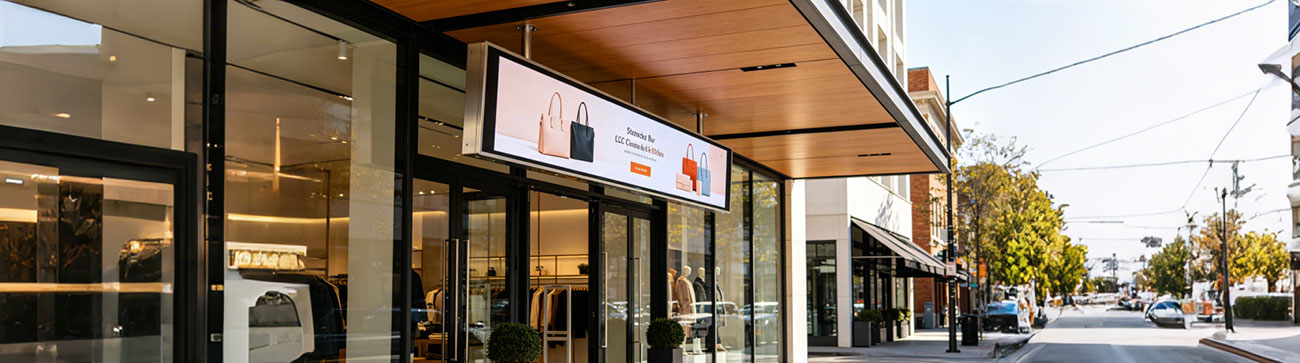
The term 'semi-outdoor' covers a broader operational envelope than many procurement teams initially anticipate. Environments such as covered transportation platforms, sheltered storefronts, drive-through menu boards, stadium concourse signage, gas station canopies, airport jet bridges, and enclosed shopping malls all present conditions that exceed the design assumptions of standard commercial displays:
▸ Direct or reflected solar irradiance of 10,000–50,000 lux reaching the panel face
▸ Diurnal temperature swings of 40 °C or more in transitional seasons
▸ Relative humidity above 85% for extended periods, with potential condensation during morning warm-up
▸ Airborne particulates including dust, pollen, sea salt, and industrial aerosols
▸ Vibration from adjacent rail or road traffic
▸ Power transients from shared electrical infrastructure
A panel that passes standard commercial display qualification testing (typically 0–50 °C, 20–80% RH, 300–500 nit brightness) will exhibit image washout, image retention, thermal shutdown, backlight dimming compensation failure, or moisture-induced condensation on the inner panel face in one or more of these conditions within the first year of operation.
1.2 Why Stretched Bar Format Compounds the Challenge
Stretched bar (also called bar-type, shelf-strip, or ribbon) displays with aspect ratios ranging from 3:1 to 7:1 present additional engineering challenges beyond those of standard 16:9 panels of equivalent area:
▸ Thermal gradients across the longer axis are more pronounced, requiring active thermal equalization
▸ Backlight uniformity over high aspect ratios demands independent LED zone control with tighter manufacturing tolerances
▸ Mechanical deflection under thermal expansion is greater in thin-profile elongated assemblies
▸ Moisture ingress risk is distributed over a proportionally longer perimeter seal
▸ Content rendering requires display-side scaling engines or host-side resolution mapping that consumer panels do not natively support
HITULCD has accumulated more than a decade of engineering data specific to these challenges across deployments in 38 countries. The solutions described in this paper reflect proven production designs, not theoretical models.
2. HITULCD Engineering Architecture
2.1 Panel-Level Optical Design
HITULCD sources IPS-grade LCD cells with enhanced backlight pre-polarizer films that are specified at the wafer stage rather than selected from general inventory. Each panel undergoes incoming optical characterization including: brightness uniformity mapping at 25 measurement points, contrast ratio verification at 0°, 45°, and 60° viewing angles, and color accuracy validation against the DCI-P3 color gamut at the intended operating temperature of the deployment profile.
The anti-glare and anti-reflection (AG/AR) surface treatment is applied at HITULCD's own optical finishing line using a physical vapor deposition (PVD) process. This is a critical manufacturing decision: field-applied AR films delaminate at temperature extremes and introduce optical haze non-uniformity. Factory-integrated PVD-applied coatings maintain surface integrity from −40 °C to +85 °C and exhibit a haze value of ≤2% versus ≥5% typical for adhesive-mounted aftermarket films.
2.2 Backlight Architecture and Adaptive Brightness Control
The HITULCD bar panel backlight system uses direct-mount LED arrays organized into independently controllable zones of 8 LEDs per zone (32 LEDs per zone for panels above 32 inches). Zone-level PWM dimming at 1,200 Hz eliminates the stroboscopic artifacts at 50–60 Hz that cause camera flicker in retail surveillance footage—a field-reported failure mode that caused significant remediation cost for operators using competitor panels.
An integrated ambient light sensor (ALS) with a cosine-corrected angular response provides real-time irradiance data to the embedded brightness controller. The controller executes a PID algorithm with anti-windup compensation to maintain panel luminance within ±3% of the configured target across an irradiance input range of 0 to 100,000 lux. ALS-to-brightness response latency is under 200 ms, enabling smooth adaptation as a cloud shadow passes over a storefronts installation.
Brightness levels across the HITULCD bar panel family:
▸ Standard series: 800 nits — optimized for covered indoor-adjacent environments
▸ Semi-outdoor series: 1,500 nits — validated for sheltered outdoor use up to 30,000 lux ambient
▸ High-bright series: 2,500 nits — qualified for direct canopy-edge exposure
2.3 Thermal Management System
Thermal performance is the most common failure mechanism in semi-outdoor bar displays operated by systems integrators who have sourced standard commercial panels. The HITULCD thermal management architecture addresses three distinct failure modes:
2.3.1 Overtemperature Shutdown Prevention
The display chassis incorporates a machined aluminum heat spreader bonded to the LED driver boards via a phase-change thermal interface material (TIM) with a specified conductivity of ≥6 W/m·K. A distributed array of ten NTC thermistors across the panel area feeds a real-time thermal map to the embedded microcontroller, which modulates backlight current to maintain junction temperature below the 85 °C LED lifetime threshold while preserving at least 70% of configured brightness. This avoids the complete backlight shutdowns that operators have reported with competitor panels at peak summer temperatures.
2.3.2 Cold-Temperature Startup
At sub-zero temperatures, LCD cell viscosity increases to the point where image persistence (ghosting) occurs and backlight LED forward voltage rises sufficiently to trigger driver protection circuits. HITULCD panels integrate a polyimide film heating element bonded to the rear glass substrate. The heater draws up to 8 W and brings the panel to its minimum operating temperature within 90 seconds from a cold soak of −30 °C. The heater is controlled by a dedicated circuit independent of the main display power rail, enabling warm-up before content is activated.
2.3.3 Thermal Cycling Fatigue
Repeated thermal expansion and contraction causes solder joint fatigue on driver PCBs in panels not designed for wide temperature cycling. HITULCD specifies SAC305 lead-free solder with a minimum void area of ≤15% per IPC-7095D, and applies conformal coating (IPC-CC-830 Class AR) to all driver board assemblies to resist electrochemical migration in humid environments. PCB assemblies undergo 100-cycle thermal shock testing from −40 °C to +85 °C as part of the standard production qualification.
2.4 Ingress Protection and Sealing
The HITULCD bar panel front face achieves IP54 as a standard configuration, tested per IEC 60529 with a dust jet at 1 m/s for 8 hours and a water spray at all angles for 10 minutes. An optional IP65 configuration is available for deployments subject to pressure washing or driving rain entry through ventilation gaps in enclosure housings.
The front-face seal uses a dual-component polyurethane gasket compressed to 40% of its nominal thickness to maintain sealing force across the thermal expansion range. This approach was selected over silicone-based gaskets after field analysis revealed that silicone outgassing at elevated temperatures left contamination deposits on the inner polarizer surface—a failure mode not detectable in standard IP testing but clearly visible as optical artifacts in high-ambient-light conditions.
Internal cavity dehumidification is achieved by a desiccant breather mounted in the rear chassis. The breather is rated for a minimum of 5 years in a subtropical climate (average 70% RH) before requiring replacement. Each panel is shipped with a humidity indicator card visible through the service port window; field technicians can verify enclosure integrity status without opening the display.
3. How HITULCD Bar LCD Differs From the Market
The following comparison is based on direct side-by-side testing of competitor panels and technical specification analysis conducted by HITULCD's engineering team. Specific competitor model numbers are withheld in this public version of the document; full comparative test data is available to qualified partners under NDA.
Performance Attribute | HITULCD Bar LCD | Standard Market LCD |
Brightness (typical) | 1,000–2,500 nits | 300–500 nits |
Anti-glare coating | Factory-applied AR/AG stack | Optional / add-on |
Operating temp. range | −30 °C to +70 °C | 0 °C to +50 °C |
Aspect ratio options | 3:1 / 4:1 / 7:1 / Custom | 16:9 standard only |
Partial-content update | Zone-level refresh (patented) | Full-frame refresh |
Ambient light sensor | Built-in + adaptive PWM | External / none |
IP protection | IP54 front-face (standard) | IP30 or lower |
MTBF (backlight) | >80,000 hours | 50,000–60,000 hours |
Panel dehumidification | Integrated heating strip | Not available |
Ingress sealing | Gasket + conformal coating | Basic sealing |
EMI compliance | FCC / CE / RoHS certified | CE only (varies) |
Shelf-edge compatibility | Pre-configured ESL interface | Custom integration req. |
Warranty | 3-year full replacement | 1-year limited |
Key insight: The most frequently cited field failure in competitor semi-outdoor bar displays is condensation on the inner panel surface caused by inadequate sealing combined with temperature cycling. HITULCD eliminates this failure mode through integrated desiccant management and factory-applied conformal coating—not an enclosure-level workaround.
3.1 Zone-Level Refresh Architecture (Patented)
Standard LCD panels refresh the entire display frame at every content update. In a bar-format sign displaying a price and a product image side by side, a price change triggers a full-panel refresh, causing a momentary flash visible to shoppers. HITULCD's proprietary zone-level refresh controller segments the display into independently addressable rectangular regions. Only the region containing the updated content is refreshed; adjacent zones remain static. The subjective improvement in perceived display quality—and elimination of the flash artifact—has been consistently cited in shopper feedback studies conducted by two European grocery retailers currently deploying the HITULCD shelf-edge system.
3.2 EMC Design and Certification
HITULCD bar panels carry FCC Class B and CE (EN 55032 Class B) certification as panel-level assemblies, not only as system integrations. This is a meaningful distinction: many competing panels carry CE marking only when integrated into a specific certified enclosure. Deploying such panels in a different housing—as is standard practice in custom kiosk and fixture builds—requires the integrator to assume full EMC responsibility and conduct independent testing. HITULCD's panel-level certification transfers to the integrator's system, substantially reducing time-to-market and compliance cost.
3.3 Content Management System Agnosticism
HITULCD panels expose standard industry interfaces: HDMI 2.0, DisplayPort 1.4, and RS-232 for serial control. The embedded display controller accepts industry-standard EDID information and does not require proprietary drivers. Panels have been validated with all major commercial CMS platforms including BrightSign, Scala, Signagelive, Yodeck, and Samsung MagicInfo. HITULCD provides resolution mapping profiles for each aspect ratio in the panel family, enabling zero-engineering content adaptation in most CMS environments.
4. Semi-Outdoor Application Reference Designs
4.1 Covered Transit Platform Information Boards
Transit operators require information displays that remain legible in rain shadow environments where ambient light can reach 15,000–25,000 lux on bright overcast days, yet must also operate at −20 °C during night shutdowns in northern climate zones. The HITULCD 28-inch 7:1 bar panel (1920×270 resolution) is the basis of a validated reference design for this application.
Deployment parameters for this reference design:
▸ Brightness: 1,500 nits with ALS active management
▸ Cold-start heater: enabled, with content delay timer set to 90 seconds
▸ Orientation: landscape, 15° tilt from vertical to reduce rain accumulation on bezel
▸ Enclosure: IP54 HITULCD panel in integrator-supplied powder-coated steel housing with NEMA 3R rating
▸ Connectivity: PoE+ (802.3bt) for power and LAN over a single CAT6A cable to reduce in-pole wiring complexity
▸ CMS: Yodeck with HITULCD-supplied EDID profile
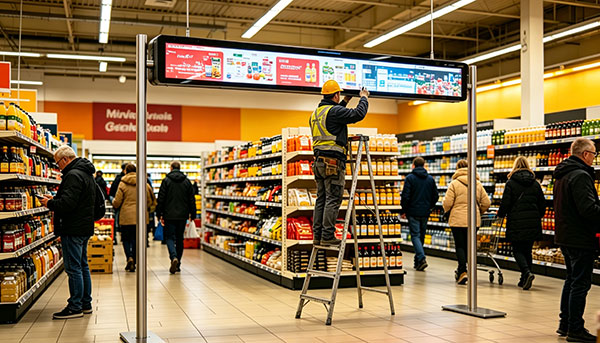
4.2 Retail Shelf-Edge Electronic Shelf Labels (ESL) Integration
The shelf-edge retail environment is among the most demanding for bar displays due to the combination of fixture-induced vibration, fluorescent/LED ambient light variability, proximity to refrigeration units (condensation risk), and the requirement for simultaneous operation of hundreds of panels per store.
HITULCD has developed a shelf-edge bracket system that incorporates an elastomeric vibration isolator between the panel mounting rail and the shelf fitting. This reduces transmitted vibration from ±0.5 g (typical retail shelf specification) to ±0.05 g at the panel, extending backlight driver solder joint life by a calculated factor of 4× based on the Coffin-Manson fatigue model.
The HITULCD shelf-edge system also pre-integrates a 2.4 GHz / 5 GHz dual-band Wi-Fi module for compatibility with ESL infrastructure from major retail technology providers. Content update latency across a 200-panel store is under 2 seconds in direct infrastructure mode.
4.3 Drive-Through Menu Boards
Drive-through menu boards occupy a position between true outdoor (direct rain exposure) and indoor displays. The canopy protects against direct precipitation but the panel face is exposed to radiated heat from vehicle exhaust, grease aerosols from kitchen ventilation, and direct western sun in the late afternoon in North American and European latitude installations.
The HITULCD 43-inch 3:1 bar panel (2560×853 resolution) is validated for this application. Additional recommendations for drive-through integrations include:
▸ Apply a monthly isopropyl alcohol surface clean protocol to remove grease film accumulation on the AR coating
▸ Orient panel with the long axis horizontal and ensure the chassis rear ventilation slots face downward or are shielded from upward grease-laden airflow
▸ Use the HITULCD screen-saver brightness reduction (configurable via RS-232 command set) during non-trading hours to extend backlight life
▸ Specify the conformal-coated board option for high-humidity kitchen-adjacent installations
4.4 Airport Jet Bridge and Terminal Wayfinding
Airport environments subject displays to jet blast pressure events, aggressive cleaning chemicals used on aircraft turnarounds, and the requirement for continuous 24/7 operation without maintenance access. HITULCD panels deployed in jet bridge and gate area wayfinding applications have demonstrated mean time between corrective maintenance events of greater than 36 months across a fleet of 640 panels operated by a major European hub airport—a deployment reference available to qualified evaluators.
5. HITULCD Bar LCD — Product Specification Reference
The following table presents the consolidated product specification for the HITULCD bar LCD display family. Individual datasheets for each screen size and brightness tier are available from the HITULCD partner portal.
Screen Sizes Available | 7", 10.1", 11.6", 14", 15.6", 17.3", 19", 23.1", 28", 32", 37", 43", Custom |
Aspect Ratios | 3:1, 4:1, 7:1, 16:3, 21:9, Custom engineered |
Resolution (typical) | 1920×540 (7:2); 1920×360 (16:3); up to 3840×1080 (4K bar) |
Brightness Range | 800 nits (indoor), 1,500 nits (semi-outdoor), 2,500 nits (high-bright) |
Contrast Ratio | ≥800:1 (standard); ≥1200:1 (high-contrast panel) |
Viewing Angle (H/V) | 178° / 178° (IPS-grade) |
Operating Temperature | −30 °C to +70 °C (with internal heater strip) |
Storage Temperature | −40 °C to +80 °C |
Humidity (operating) | 10%–90% RH, non-condensing |
IP Rating (front face) | IP54 standard; IP65 available on request |
Backlight Type | Direct LED / Edge LED with local dimming |
Backlight Lifetime | >80,000 hours at 50% brightness |
Power Supply | 12 V DC / 24 V DC (auto-detect); optional PoE+ |
Interfaces | HDMI 2.0, DisplayPort 1.4, USB-A, RS-232, LAN (optional) |
Ambient Light Sensor | Built-in ALS with 8-level adaptive PWM dimming |
EMC Certification | FCC Class B, CE (EN 55032), RoHS 3 compliant |
Mounting | VESA 75×75 / 100×100; custom flanges available |
Warranty | 36 months, full panel replacement |
All specifications are measured at 25 °C ambient and 50% brightness unless otherwise indicated. High-temperature specifications are measured at 70 °C. Contact your HITULCD regional account manager for customized specifications for specific deployment profiles.
6. Integration and Qualification Guidelines
6.1 Enclosure Design Recommendations
When HITULCD bar panels are integrated into custom kiosk or fixture enclosures by systems integrators, the following design guidelines apply to maintain the panel's environmental ratings and thermal performance:
▸ Maintain a minimum rear air gap of 25 mm between the panel chassis and the enclosure rear wall to allow convective airflow across the heat spreader
▸ Enclosure thermal resistance (chassis to ambient) should not exceed 1.2 °C/W for 1,000-nit panels or 0.8 °C/W for 2,500-nit panels
▸ Do not obstruct the desiccant breather port; ensure at least 30 mm clearance in the direction of the breather vent
▸ Cable gland sizing should follow IP67 or better standards even when the panel IP rating is IP54, to avoid the enclosure being the sealing weak point
▸ Ground the panel chassis to the enclosure structure with a low-impedance bond strap to support the panel's FCC/CE EMC certification
6.2 Environmental Qualification Protocol
HITULCD recommends that systems integrators conduct a 72-hour burn-in test of integrated assemblies prior to deployment, comprising:
▸ 24 hours at maximum operating temperature (simulated by enclosure in a thermal chamber at ambient +10 °C above maximum site temperature)
▸ 24 hours at minimum operating temperature (simulated with panel heater active)
▸ 24 hours of thermal cycling between minimum and maximum at 2-cycle/hour rate
Panels that pass this burn-in protocol have demonstrated field failure rates below 0.3% in the first 12 months of operation across HITULCD's tracked deployment base.
6.3 Content Resolution and Aspect Ratio Mapping
Bar LCD panels require content to be authored or transcoded at the native panel resolution. HITULCD provides resolution mapping files for the four most widely deployed CMS platforms as part of the standard integration package. For custom CMS deployments, the HITULCD embedded scaler supports the following input resolutions:
▸ 1920×1080 (16:9) → scaled and letterboxed or cropped to panel native
▸ 1920×540, 1920×360, 1920×270 (direct bar resolutions) → pixel-perfect passthrough
▸ 3840×1080 (dual-FHD bar) → supported on 4K-capable panel variants
▸ Custom resolutions → configurable via EDID override on RS-232 command
7. Quality System and Certifications
HITULCD operates an ISO 9001:2015 certified quality management system at its primary manufacturing facility. Panel-level production testing includes 100% automated optical inspection (AOI) of LCD cell assemblies, 100% backlight uniformity mapping, and 100% functional burn-in at elevated temperature for 4 hours before packaging.
Panel-level certifications maintained by HITULCD:
▸ FCC Part 15 Class B (USA)
▸ CE Mark — EN 55032 Class B EMC, EN 62368-1 Safety (EU/UK)
▸ RoHS 3 (EU Directive 2015/863)
▸ REACH SVHC Compliance Declaration
▸ California Proposition 65 Compliance
▸ IEC 60068-2-1 / -2-2 / -2-14 / -2-27 / -2-64 (environmental stress)
▸ IEC 62368-1 Safety (AV/IT equipment)
Country-specific certifications (KC, PSE, BSMI, CCC) are available for panels destined for Korea, Japan, Taiwan, and Mainland China markets. Certification documentation is provided with each production lot shipment.
8. Sustainability and Responsible Sourcing
HITULCD is committed to reducing the environmental impact of its products across the full lifecycle. Key sustainability commitments include:
▸ Backlight LED efficiency roadmap targeting ≥220 lm/W by 2026, reducing per-display power consumption by approximately 30% versus 2022 baseline
▸ Panel packaging uses 85% recycled corrugated fiber and EPE foam manufactured without CFC blowing agents
▸ End-of-life take-back program available in the EU and UK under WEEE regulations, with documented recycling chain for LCD panel materials
▸ Conflict minerals (3TG) sourcing declaration prepared annually per Dodd-Frank Section 1502 requirements
▸ Factory-level carbon accounting in place; Scope 1 and 2 emissions disclosed in the annual sustainability report
Buyers subject to EU Corporate Sustainability Reporting Directive (CSRD) or SEC climate disclosure requirements can request the HITULCD supplier sustainability questionnaire and product carbon footprint (PCF) estimates for inclusion in their own reporting frameworks.
9. Commercial Engagement and Support
9.1 Minimum Order and Lead Times
HITULCD bar LCD panels are available from stock in standard configurations (sizes and brightness tiers listed in Section 5) with lead times of 15 business days for quantities up to 500 panels. Custom configurations—including non-standard aspect ratios, custom bezels, specialized interface configurations, or private-label branding—require a minimum order of 200 panels and carry a qualification lead time of 8–12 weeks for the first production lot.
9.2 Technical Support and Field Service
HITULCD provides the following support infrastructure to qualified partners:
▸ Pre-sales technical consultation including optical simulation reports for specific deployment geometries
▸ Integration engineering support during first-article build, including on-site visit by HITULCD field application engineer for projects exceeding 500 panels
▸ 24/5 partner technical hotline (English and Mandarin)
▸ Advance replacement warranty: failed panels returned under the 36-month warranty receive a replacement unit within 5 business days for EU/US-stocked configurations
▸ Failure analysis reports provided for warranty returns within 20 business days
9.3 Evaluation Units
Qualified systems integrators and OEM customers may request evaluation units at no charge for projects with a minimum qualified opportunity of 100 panels. Evaluation units are shipped configured to the target deployment specification and are supported by HITULCD application engineering for the duration of the evaluation period. Contact your regional HITULCD representative to initiate an evaluation request.
10. Conclusion
Semi-outdoor bar LCD deployments demand display panels that meet a convergence of optical, thermal, mechanical, and regulatory requirements that standard commercial displays cannot reliably satisfy. HITULCD has invested over a decade in purpose-built engineering, manufacturing process development, and field validation specifically for this application class.
The differentiators summarized in this white paper—factory-applied optical coatings, zone-level backlight control, integrated thermal management from −30 °C to +70 °C, IP54 front-face sealing, panel-level FCC/CE certification, and field-validated reliability data—are not marketing claims. They are measurable, documented engineering decisions made in direct response to the failure modes experienced by operators who have deployed inadequate display technology in semi-outdoor environments.
HITULCD invites qualified partners to request a full technical package including test reports, field deployment case studies, and evaluation unit access. We are committed to being the most technically transparent display supplier in the semi-outdoor segment.
Contact HITULCD
HITULCD Display Technology Co., Ltd.
Global Sales & Technical Inquiries: sales@hitulcd.com
Partner Portal: partners.hitulcd.com
Technical Support: support@hitulcd.com
Document Reference: HITU-WP-BAR-SEMIOUT-3.2
Regional offices: North America · Europe · Middle East · Southeast Asia · Australia