What Is a Stretched Bar Display
for Retail Shelf Digital Signage?
A Comprehensive Technical & Buyer's Guide by HITULCD
Published by HITULCD Engineering & Product Team | Updated: 2025
Executive Summary
Stretched bar displays — also referred to as shelf-edge displays, bar-type LCDs, or ultra-wide strip screens — represent one of the fastest-growing segments in retail digital signage. As global brick-and-mortar retailers accelerate their transition from static shelf labels and printed POP materials toward dynamic, data-driven digital communication, the stretched bar display has emerged as the purpose-built hardware solution for this shift.
This guide provides a definitive technical overview of stretched bar displays for retail shelf applications: what they are, how they work, why they outperform conventional displays in this use case, and — critically — how HITULCD's engineering approach sets a new benchmark that generic flat-panel and competing strip display manufacturers have yet to match.
Whether you are a retail technology director evaluating your first shelf-edge pilot program, a system integrator designing a multi-store rollout, or a purchasing manager comparing display specifications, this document will provide the technical clarity and commercial context you need to make a fully informed decision.
1. Defining the Stretched Bar Display
1.1 What Is a Stretched Bar Display?
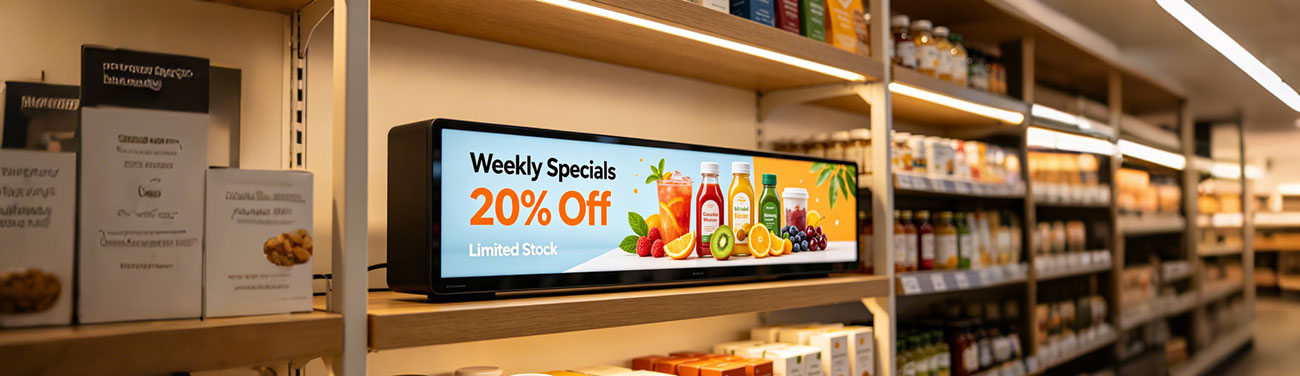
A stretched bar display is a liquid crystal display (LCD) panel engineered with an ultra-wide aspect ratio — typically ranging from 3:1 to 8:1 or beyond — as opposed to the 16:9 (widescreen) or 4:3 (standard) ratios found on conventional commercial monitors. The physical form factor is deliberately elongated and narrow, designed to fit flush against or within a retail shelf unit, gondola edge, freezer door frame, or product tray rail.
The underlying LCD technology is fundamentally the same as that found in commercial-grade flat panel displays: a TFT (thin-film transistor) matrix, a backlight assembly, polarizing layers, and a color filter. What distinguishes a stretched bar display is the panel cutting process, the aspect ratio of the active display area, the brightness engineering required to compensate for narrow panel geometries, and the integration design required to embed the display into retail furniture at the point of sale.
1.2 Common Physical Formats
Stretched bar displays for retail shelf use are produced across a wide range of standardized and custom physical sizes. The most commonly deployed form factors include:
• 23.1-inch (1920 × 360 pixels) — suited for standard 90 cm shelf bay widths
• 28.6-inch (1920 × 360 pixels) — ideal for 120 cm bay widths in grocery and hypermarket environments
• 37.1-inch (1920 × 360 pixels) — frequently deployed in DIY retail, consumer electronics, and warehouse club formats
• 10.1-inch (1280 × 390 pixels) — used in small-format convenience retail, pharmacy shelf strips, and hospitality trolley displays
• Custom aspect ratios and sizes manufactured to OEM specification — a capability central to HITULCD's value proposition
Panel orientation can be landscape (the most common retail configuration) or portrait (rotated 90°), with portrait orientation frequently used for end-cap price tower displays and vertical product category signage.
1.3 How a Stretched Bar Display Differs from a Conventional Display
The key engineering difference between a stretched bar panel and a cut-down conventional display is not simply a matter of geometry. Producing a functional, long-life stretched display requires purpose-built panel engineering at the manufacturing level, not post-production modification of standard panels. Specifically:
• Backlight uniformity: Standard backlights are engineered for square or near-square aspect ratios. A stretched panel requires a custom-designed edge-lit or direct-lit backlight array that delivers uniform luminance across an unusually long, narrow active area. Without this, brightness fall-off at the ends of the display creates unacceptable visual non-uniformity.
• Driver board design: The timing controller (TCON) and scaler electronics must be specifically designed for the panel's native resolution and unusual pixel matrix. Generic driver boards produce image distortion, color banding, and refresh artifacts when paired with non-standard panel geometries.
• Thermal management: The narrow chassis of a shelf-edge display concentrates heat from the backlight assembly in a tight physical envelope. Without purpose-designed thermal dissipation — including heat spreader materials, chassis airflow modeling, and backlight driver calibration — panel lifespan is significantly reduced.
• Mechanical integration: Retail shelf displays must be designed from the ground up for mounting integration with gondola hardware, magnetic attachment systems, snap-in shelf rail channels, or recessed bezel-free installations. A conventional display has none of these mounting provisions.
2. Applications in Retail Shelf Digital Signage
2.1 The Point-of-Sale Communication Challenge
The retail shelf edge is the single most commercially valuable piece of real estate in a physical store. It is the location where a consumer's purchase decision is made — frequently within three to seven seconds of visual engagement with a product bay. For decades, this space was occupied exclusively by paper shelf edge labels (SELs) carrying price, barcode, and a limited amount of product information.
The limitations of paper SELs are well understood by retail operations professionals: high labor cost of label reprinting and replacement, inability to communicate dynamic pricing or promotional content, no capacity for video or animation, no integration with inventory management or loyalty systems, and a static visual presence that cannot compete with the sensory richness of competitive digital advertising environments.
Stretched bar displays resolve all of these limitations within the physical constraints of an existing shelf infrastructure.
2.2 Primary Use Cases
Grocery & Supermarket
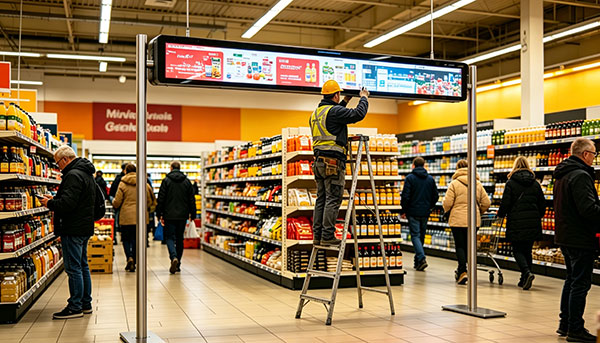
In grocery retail, stretched bar displays are deployed at the shelf edge beneath product facings. They display dynamic price information synchronized in real-time with the store's pricing management system, promotional messaging, nutritional highlights, country-of-origin data, and loyalty reward point multipliers. During promotional events, content can be updated instantaneously across all connected displays in a store or entire estate — a capability that paper labels cannot replicate.
Consumer Electronics & DIY
Large-format retail environments including consumer electronics chains and DIY home improvement stores deploy stretched bar displays on gondola uprights and shelf edge positions to communicate product comparison data, compatibility specifications, installation guides in video format, and bundle promotions. The longer 37-inch format is especially suited to these environments given the wider shelf bays characteristic of large-format retail.
Pharmacy & Health & Beauty
Pharmacy retailers use shelf-edge stretched displays to communicate regulated health claim information, dosage guidance, product differentiation messaging, and cross-sell recommendations. Integration with pharmacy dispensing systems enables real-time stock availability communication to both customers and store associates. The precision and accuracy of digital communication in this category has measurable compliance and liability implications.
Food Service & Hospitality
In food service environments, stretched bar displays are mounted on tray rails, buffet counters, beverage stations, and menu board strips. They communicate allergen information, caloric content, promotional pricing, and queue management messaging. Their resistance to humidity, temperature variation, and splash exposure — when appropriately specified — makes them viable in back-of-house and front-of-house food service settings.
Freezer & Chiller Aisle
The freezer aisle presents one of the most technically demanding environments in retail digital signage. Condensation, low ambient temperatures, and aggressive thermal cycling create conditions that cause generic LCD panels to fail prematurely through moisture ingress, backlight delamination, and adhesive failure. Proper stretched bar displays for this application require specific cold-start engineering, anti-condensation treatments, and sealed connector interfaces — engineering considerations that HITULCD addresses at the product design level.
3. Key Technical Specifications Explained
3.1 Brightness and Ambient Light Rejection
Retail environments present significant ambient light challenges. Fluorescent tube lighting, LED track lighting, and large skylights in big-box retail environments can produce ambient illuminance levels at the shelf face of 500 to 2,000 lux or above. A display operating at 250 nits — the typical brightness of an office monitor — will appear washed out, lacking contrast, and functionally invisible in these conditions.
HITULCD stretched bar displays are specified at a minimum 700 nits for standard retail applications, with high-brightness variants rated to 1,500 nits for environments with extreme overhead lighting. This brightness specification is maintained across the full operating temperature range of the display, not merely at cold start — a distinction that is frequently obscured in competitor specification sheets.
3.2 Resolution and Pixel Density
The standard resolution for a 23.1-inch shelf-edge stretched display is 1920 × 360 pixels, yielding a pixel density in the horizontal axis comparable to full HD content and sufficient for legible text at standard retail viewing distances of 0.3 to 1.5 meters. At longer shelf widths, maintaining pixel density across a 37-inch or 49-inch panel requires a minimum horizontal resolution of 1920 pixels to preserve text legibility for pricing and promotional copy.
HITULCD engineers the pixel pitch of each panel variant to maintain content legibility at the intended minimum viewing distance, and provides content specification templates to integration partners and end users that prevent common errors such as incorrect font sizing, inadequate contrast ratios, or image compression artifacts.
3.3 Connectivity and Content Management
Modern stretched bar displays for retail deployment must integrate seamlessly into the broader store technology ecosystem. HITULCD displays support multiple connectivity architectures:
• Built-in Android OS (Android 11 and above): Eliminates the need for an external media player. Content management is handled via a compatible CMS (content management system) delivered over the store's Wi-Fi or LAN infrastructure. This architecture significantly reduces hardware cost and installation complexity at scale.
• HDMI / DVI input: For integration with central media player infrastructure where a single player drives multiple displays via a distribution amplifier or daisy-chain topology.
• RS-232 and LAN control: For integration with building management systems, POS systems, or store operations platforms that require programmatic control of display power state, brightness, and input selection.
• USB media playback: For store environments without centralized CMS infrastructure, enabling scheduled content playback from removable media with no network dependency.
3.4 Operating Lifespan and Reliability
Retail digital signage is a continuous-operation application. Displays in grocery and convenience retail frequently operate 16 to 24 hours per day, seven days per week. At these operating hours, a display rated for 30,000 hours of backlight life — common in consumer and low-grade commercial panels — will require backlight replacement or full panel replacement within three to four years of deployment.
HITULCD stretched bar displays are rated at 50,000+ hours of backlight life under continuous operation conditions, representing a deployed operational lifespan of six to eight years at typical retail duty cycles. This specification has direct implications for total cost of ownership (TCO) calculations and is a primary driver of HITULCD's commercial value proposition to enterprise retail operators.
4. HITULCD Stretched Bar Displays vs. The Market
The following comparison reflects independently verifiable specifications and engineering differentiators as of 2025. HITULCD's engineering team welcomes direct technical comparison with any competitor product on a specification-by-specification basis.
Feature | HITULCD Stretched | Standard LCD | Competitor Strips |
Aspect Ratio | 3:1 ~ 8:1 custom | 16:9 only | Fixed 3:1 |
Brightness (nits) | 700 – 1,500 | 250 – 400 | 350 – 500 |
Operating Temp | -20 °C to +60 °C | 0 °C to +40 °C | 0 °C to +45 °C |
Lifespan | 50,000 hrs+ | 30,000 hrs | 40,000 hrs |
Custom Size | ✓ Yes | ✗ No | Limited |
Android/Win OS | ✓ Built-in | ✗ External only | ✗ External only |
IP Rating | IP54 optional | IP40 | IP42 |
Warranty | 3 Years | 1 Year | 1 Year |
4.1 What Makes HITULCD Different
The display industry is not short of manufacturers capable of producing a stretched bar panel to a standard specification sheet. What distinguishes HITULCD is the depth of engineering investment applied at each stage of product development, and the manufacturing discipline that translates engineering intent into consistent, field-proven product performance.
Purpose-Built Panel Engineering, Not Commodity Repurposing
A significant proportion of stretched bar displays available in the market are produced by purchasing standard LCD panels from commodity suppliers and mechanically trimming them to a narrower form factor. This approach is cost-effective at the manufacturing level but introduces fundamental reliability problems: the backlight assembly, which was engineered for the original full-width panel, is now operating outside its design envelope, producing uneven illumination, accelerated LED degradation, and thermal stress concentrations.
HITULCD sources or co-develops panel substrates that are manufactured to the target aspect ratio from the substrate cutting stage. The backlight assembly, TCON design, and chassis thermal architecture are all specified and validated for the specific panel geometry — not adapted from a standard panel design. This distinction is visible in measured brightness uniformity data, which HITULCD provides to qualified OEM customers on request.
Thermal Engineering for Continuous Retail Operation
The narrow chassis of a shelf-edge display concentrates backlight thermal output in a tightly constrained physical volume. Without active thermal management, this produces localized hotspots that accelerate LCD panel degradation, induce color shift, and reduce backlight lifespan. HITULCD's mechanical engineering team conducts computational fluid dynamics (CFD) modeling of chassis thermal behavior for each display model, validating designs through accelerated life testing at elevated temperature conditions before production release.
Cold-Chain and Freezer-Aisle Certification
HITULCD is one of a small number of manufacturers that has specifically engineered and certified stretched bar display products for deployment in freezer aisle and cold-chain environments. Key features of HITULCD's cold-environment variants include cold-start backlight management (ensuring full brightness is achieved within 30 seconds at -20°C), anti-condensation heating elements on the display face glass, IP54-rated sealed connector interfaces, and chassis materials selected for thermal expansion compatibility across the full -20°C to +60°C operating range.
Custom OEM Program
HITULCD operates a structured custom OEM program that allows retail technology integrators and retail operators to specify display form factors, bezel dimensions, mounting interface types, embedded computing configurations, and branding requirements outside the standard product catalog. Minimum order quantities for custom variants are negotiated on a project basis, with engineering support provided from initial requirements through production validation. This program has supported deployments across grocery, pharmacy, luxury retail, and food service verticals in North America, Europe, and Asia-Pacific.
Software Ecosystem Integration
HITULCD displays are validated for compatibility with the leading retail digital signage content management platforms including Scala, Signagelive, Yodeck, and Rise Vision, as well as major enterprise retail operating platforms. HITULCD's technical team maintains integration documentation and provides pre-sales technical support to assist system integrators in designing compatible content management architectures before equipment procurement.
5. Deployment Planning: What Retail Operators Need to Know
5.1 Infrastructure Requirements
Successful stretched bar display deployment requires planning across four infrastructure dimensions:
• Power distribution: Each display draw between 8W and 25W depending on size and brightness specification. A typical 4-bay gondola section with one display per shelf level across six shelf levels requires provision for approximately 150W of continuous power draw, plus appropriate circuit protection and cable management within the gondola infrastructure.
• Network connectivity: Wi-Fi or wired LAN connectivity must be provided at the display location for CMS-driven content update. Store Wi-Fi infrastructure should be assessed for signal coverage at shelf level before deployment planning is completed — signal attenuation from metal gondola uprights is a common source of connectivity issues in pilot deployments.
• Content management system: A CMS with native support for stretched display resolutions and aspect ratios is essential. Standard 16:9 CMS templates require adaptation for 3:1 or greater aspect ratios. HITULCD provides resolution-specific template packs and content specification guidelines to customers.
• Mounting and installation hardware: HITULCD supplies gondola-specific mounting hardware for the major shelf system standards used in UK, European, and North American retail environments, including standard 60mm and 50mm pitch rail systems.
5.2 Total Cost of Ownership Modeling
The business case for shelf-edge digital signage investment is most accurately evaluated on a total cost of ownership basis over a five-to-seven-year operational horizon. Key TCO components include:
• Hardware acquisition cost: Display unit cost including mounting hardware and any required media players
• Installation labor: Per-bay installation time, electrical work, and network provisioning
• CMS licensing: Per-display or per-site software licensing for content management platform
• Maintenance and replacement: Expected panel replacement rate over the operational horizon, based on published MTBF data and field failure rates
• Content production: Ongoing cost of producing and scheduling digital content
When evaluated on this basis, HITULCD's higher unit cost relative to commodity alternatives is consistently offset within 24 to 36 months by lower failure rates, reduced maintenance labor, and extended hardware lifespan — a calculation that HITULCD's commercial team can model in detail for qualified project opportunities.
6. Frequently Asked Questions
Can stretched bar displays be used outdoors or in semi-outdoor environments?
HITULCD produces high-brightness stretched bar display variants suitable for covered outdoor and semi-outdoor environments such as forecourt canopies, covered market halls, and enclosed shopping centre atriums. These variants are specified at 1,500 nits minimum brightness and feature IP54-rated enclosures. Fully exposed outdoor applications require a different product category (outdoor-rated displays with active temperature management) and should be discussed with HITULCD's technical sales team.
What is the minimum order quantity for custom-size panels?
Minimum order quantities for custom OEM panel sizes vary based on the degree of customization required. Standard catalog modifications (bezel color, custom branding, OS configuration) can be accommodated at quantities from 50 units. Full custom panel geometry requires a more significant minimum commitment and involves an NRE (non-recurring engineering) cost for tooling and validation. HITULCD's OEM team will provide a detailed project assessment upon receipt of a requirements brief.
How are content updates managed across a large estate of displays?
For large multi-site estates, HITULCD recommends deployment of a cloud-hosted CMS platform with device management capability. Content updates can be scheduled centrally and distributed to displays via the store network, with individual display or display group targeting capability. HITULCD's displays support remote monitoring of operational status, enabling proactive identification of connectivity or hardware issues before they impact the customer experience.
What warranty and after-sales support does HITULCD provide?
HITULCD stretched bar displays carry a standard three-year manufacturer's warranty covering defects in materials and workmanship under normal operating conditions. Extended warranty terms of up to five years are available by arrangement for enterprise-scale programs. HITULCD provides technical support via a dedicated commercial support desk staffed by engineers with direct knowledge of the product range — not third-party service desk operations.
Conclusion: The Strategic Case for Stretched Bar Displays in Retail
The stretched bar display is not a peripheral product category in retail digital signage — it is the enabling technology for the next generation of shelf-edge communication, price management, and shopper engagement in physical retail. The retailers and retail technology providers that deploy well-engineered, long-life stretched bar displays now are building a digital communication infrastructure that will define their competitive positioning across the remainder of this decade.
HITULCD's position in this market is founded on engineering depth, manufacturing discipline, and a proven track record of supporting enterprise retail programs from initial pilot through multi-market rollout. We manufacture to a higher standard because our customers operate in environments where display failure has direct commercial consequences — and we stand behind our products with the warranty terms, support infrastructure, and technical expertise to demonstrate that commitment.
To discuss your retail shelf display program — whether at the pilot planning stage, specification development, or full commercial rollout — contact HITULCD's commercial team. We provide pre-sales technical consultation, reference site visits where applicable, and detailed commercial proposals tailored to your program requirements.
HITULCD — Professional Stretched Bar Display Solutions
www.hitulcd.com | chenhua@hitulcd.com | Technical Support: chenhua@hitulcd.com
© 2025 HITULCD. All technical specifications subject to change without notice. All rights reserved.