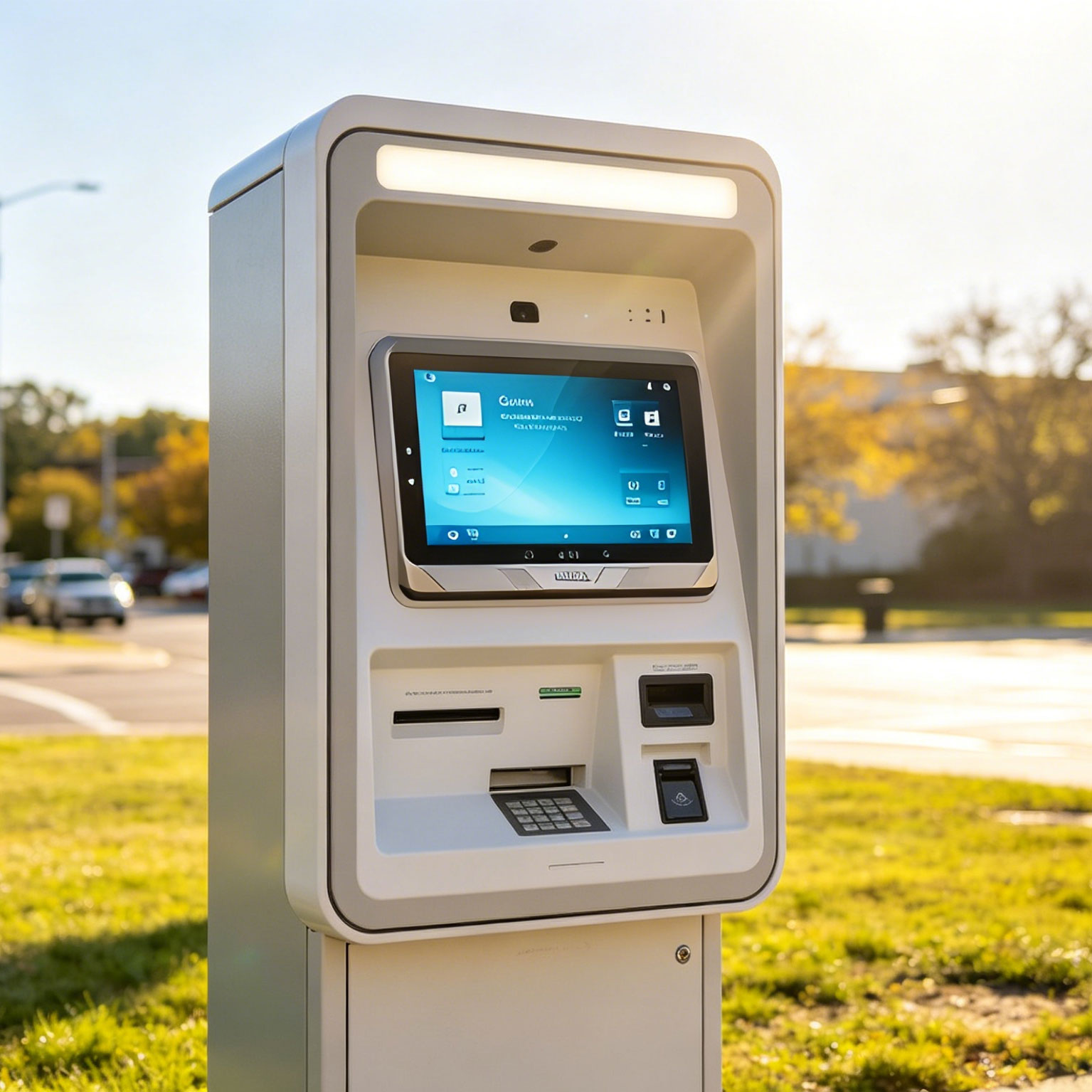
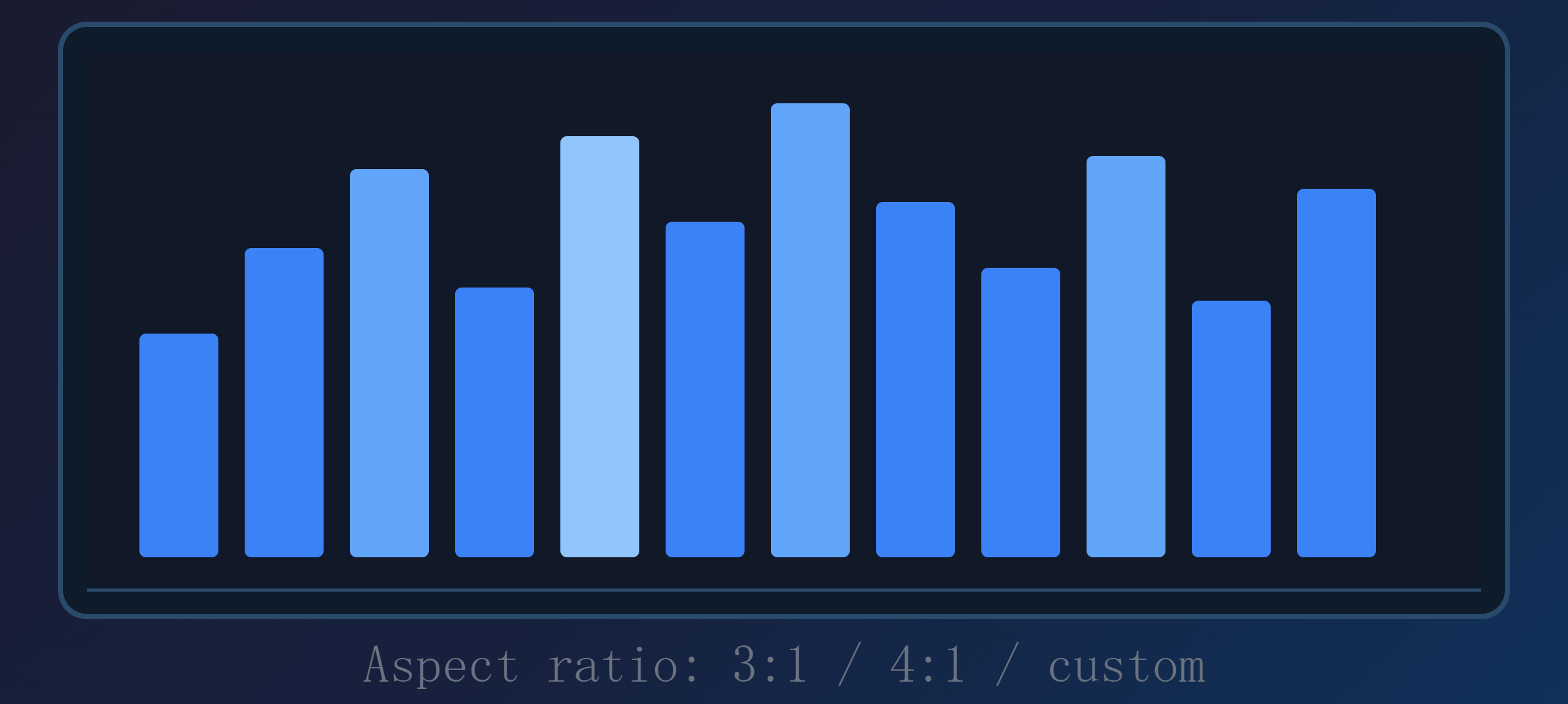
| Type | Flat panel display |
| Subtype | Bar-form factor |
| Common ratios | 3:1, 4:1, 5:1, up to 32:9 |
| Typical resolution | 1920×480 to 3840×1080 |
| Backlight | LED, Mini-LED |
| Panel types | TN, IPS, VA |
| Common sizes | 19″–49″ diagonal |
| Applications | Digital signage, HMI, automotive, retail |
A stretched bar display (also referred to as a bar-type display, ribbon display, or shelf-edge display) is a category of flat-panel monitor distinguished by an extreme horizontal aspect ratio, typically ranging from 3:1 to 16:1 or beyond, that produces a narrow, elongated screen geometry substantially wider than it is tall.[1] Unlike conventional widescreen monitors conforming to 16:9 or 21:9 standards, stretched bar displays are designed primarily for embedded information delivery, digital signage, point-of-sale systems, and industrial human–machine interfaces (HMI) rather than general-purpose computing or entertainment.[2]
The category emerged commercially during the mid-2000s as LCD manufacturing techniques matured, enabling cost-effective production of non-standard panel cuts from standard-sized glass substrates. Today, stretched bar displays are ubiquitous in transportation hubs, retail shelf edges, automotive dashboards, and industrial control panels, with the global market for the category estimated at several hundred million US dollars annually.[3]
Definition and terminology
The term "stretched bar display" derives from the visual analogy of taking a conventional display panel and stretching it along its horizontal axis to produce a ribbon-like form factor. Industry literature and manufacturer datasheets use several interchangeable designations:
Bar-type LCD — the most technically precise designation used in panel manufacturer specifications, emphasizing the physical form factor of the glass substrate.
Shelf-edge display — a retail-industry term referring to units designed to mount at the front edge of supermarket or warehouse shelving, replacing traditional paper price tags with a dynamic digital interface.[4]
Ultra-wide strip display — used predominantly in architectural and venue signage contexts, where multiple units may be tiled horizontally to create continuous information ribbons along building façades or stadium perimeters.
A defining characteristic that differentiates stretched bar displays from other display categories is the intentional subordination of vertical resolution. Whereas a high-definition display allocates resolution in both axes to maximise image fidelity, a stretched bar display sacrifices vertical pixel count in exchange for the greatest possible horizontal span within a given footprint, optimising for the display of scrolling text, horizontal graphs, status indicators, or narrow-format imagery.[5]
History
The conceptual precursor to the modern stretched bar display can be traced to the vacuum-fluorescent displays (VFDs) and segmented LED arrays used on supermarket checkout registers and petrol-pump interfaces during the 1970s and 1980s. These early devices already demonstrated that consumer-facing informational displays need not conform to the square or mildly rectangular geometries of television screens.[6]
The first LCD-based bar displays appeared in the late 1990s in industrial instrumentation. Manufacturers such as Seiko Epson and Sharp produced custom-cut LCD modules for embedded applications, primarily supplying OEM clients integrating displays into medical equipment and handheld industrial terminals. These early units were small, typically fewer than 10 inches diagonally, and used passive-matrix or early TFT construction with limited brightness.
A significant expansion of the category occurred between 2005 and 2010, driven by two converging factors: the widespread adoption of glass-substrate LCD manufacturing at Generation 5 and Generation 6 fab scales, which produced large mother-glass panels from which non-rectangular cuts became economical; and the rapid growth of digital out-of-home (DOOH) advertising, which created commercial demand for visually distinctive display form factors.[7] Manufacturers including Litemax, Philips Signage, and later Samsung and LG began offering catalogue-standard bar-type panels in sizes from 19 to 38 inches diagonal.
The 2010s saw the category mature, with standardisation of common resolutions (notably 1920×480 and 1920×540), widespread integration into retail electronic shelf label (ESL) infrastructure, and adoption by automotive OEMs for instrument-cluster and rear-passenger-entertainment applications. The introduction of mini-LED backlighting after 2018 enabled high-brightness bar displays capable of outdoor-rated luminance exceeding 1,500 cd/m², expanding deployment into outdoor environments previously served only by LED matrix signage.[8]
Technical specifications
Aspect ratio and resolution
Stretched bar displays are defined by aspect ratios substantially exceeding the 16:9 (approximately 1.78:1) standard of widescreen monitors. Common commercial ratios include:
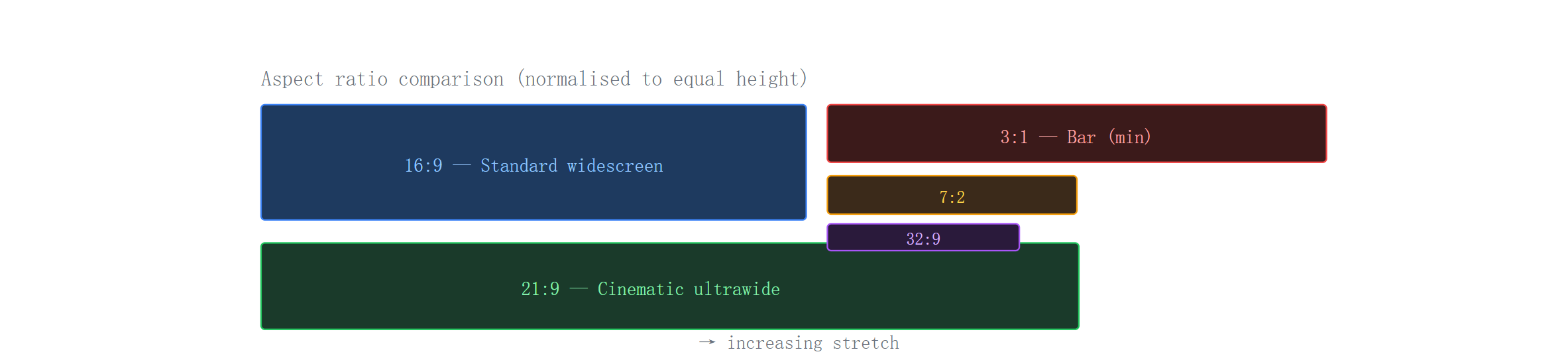
Standard resolutions mapped to common bar-type aspect ratios are approximately as follows. A 3:1 panel at HD vertical resolution (480 pixels) yields 1440×480; at FHD vertical resolution (540 pixels), the common 1920×540 module results. A 4:1 panel commonly appears as 1920×480. Higher-end units conform to 3840×1080, effectively two Full HD panels combined horizontally, enabling tiled or mirrored content from standard HDMI or DisplayPort 1.2 sources without GPU-level resolution remapping.[9]
The effective pixel density (PPI) of stretched bar displays is typically lower than equivalent-diagonal widescreen monitors. A 37-inch bar panel at 1920×540 resolves approximately 52 PPI horizontally, well below the 100–110 PPI typical of a 37-inch 1080p display. This is considered acceptable in most deployment scenarios because viewing distances in signage and HMI applications are substantially greater than those of workstation monitors, and content is formatted for the available resolution rather than requiring sub-pixel rendering of fine text.[10]
Panel technologies
Bar-type displays are produced using the same active-matrix thin-film transistor (AMTFT) technologies as conventional flat panels. The three dominant panel technologies — TN (twisted nematic), IPS (in-plane switching), and VA (vertical alignment) — each present distinct trade-offs in the stretched-bar context:
TN panels are historically common in lower-cost bar displays owing to their faster pixel response times and lower manufacturing cost. Their narrow viewing angles, typically ±60° horizontal and ±40° vertical, are less problematic in a horizontally elongated format where vertical viewing-angle variation is minimal, but restrict utility in overhead or portrait-orientation mounting.
IPS panels offer substantially wider viewing angles (typically ±85° on both axes) and superior colour accuracy, making them the preferred substrate for retail digital signage and high-end automotive applications. The additional manufacturing cost is often justifiable where colour consistency across wide horizontal viewing arcs is required, as in transportation information displays observed from acute angles.[11]
VA panels provide the highest native contrast ratios of the three technologies, often exceeding 3000:1 without local dimming, and are used in applications requiring legible displays in highly variable ambient illumination — notably outdoor kiosks and sunlit retail environments.
OLED-based bar displays exist but remain uncommon at larger sizes due to burn-in vulnerability under static signage content and the elevated cost of large-format OLED substrates. Micro-LED technology is under active development for bar-form-factor applications as of the early 2020s.[12]
Brightness and contrast
Brightness requirements for stretched bar displays vary significantly by deployment environment. Indoor retail and office applications typically specify 700–1,000 cd/m² to overcome ambient illumination without excessive power consumption. Semi-outdoor environments, such as transit station platforms with indirect sunlight, require 1,500–2,500 cd/m². Fully outdoor-rated displays must achieve 2,500–5,000 cd/m² for legibility under direct solar irradiance, necessitating enhanced backlighting arrays and thermal management solutions.[13]
The optical bonding technique — in which the air gap between the LCD panel and a protective front glass is filled with an optically clear resin — is widely adopted in stretched bar displays intended for high-ambient-light environments. By eliminating the internal reflective air interface, optical bonding reduces parasitic reflection by approximately 70%, improving effective contrast in sunlight and permitting the same apparent luminance at lower backlight power, extending LED lifespan.[14]
Applications
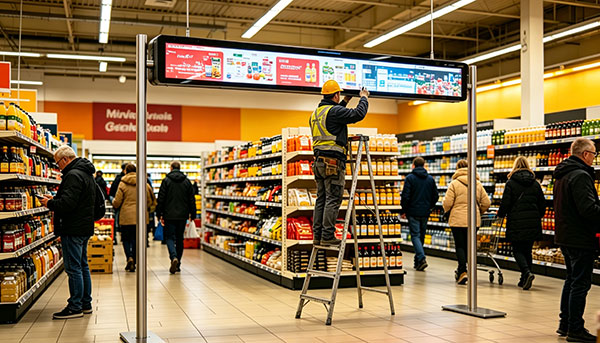
Digital signage and retail. Stretched bar displays are ubiquitous in retail environments, appearing as shelf-edge electronic labels, promotional displays mounted along gondola tops, and queue management boards above service counters. The form factor matches shelf geometry naturally, minimising the visual footprint of the display hardware while maximising the horizontal span of legible product or pricing information.[15]
Transportation infrastructure. Train stations, airports, bus terminals, and metro systems deploy bar-type displays along platform edge screens, gate information boards, and overhead departure/arrival strips. The horizontally elongated format accommodates the natural reading flow of timetable data — destination, departure time, platform, status — without requiring a full-width conventional monitor at each information point.
Automotive instrument clusters. Modern vehicle dashboards increasingly incorporate stretched bar displays replacing discrete analogue gauges. A single bar-type panel spanning the instrument cluster can simultaneously render speed, fuel level, engine temperature, navigation guidance, and driver-assistance indicators. OEM implementations from manufacturers including Mercedes-Benz, Volkswagen Group, and Hyundai-Kia have adopted multi-zone bar panels with resolutions up to 3920×720 pixels across the full dashboard width.[16]
Industrial HMI and process control. In industrial settings, stretched bar displays serve as status-line interfaces on machine control panels, conveyor management systems, and clean-room process monitors, where the vertical profile of the display must be minimised to fit within equipment enclosures that prioritise functional compactness over display area.
Gaming and simulation peripherals. A niche but growing application involves use of bar-type panels as secondary displays in simulation cockpits, racing simulator rigs, and broadcasting studio environments, where the elongated format complements the primary display by providing secondary instrument information, chat feeds, or telemetry data without intruding on the main field of view.
Manufacturing considerations
Production of bar-type LCD panels follows the same photolithographic processes as standard LCD manufacturing, but requires non-rectangular substrate cutting. In modern LCD fabs, mother-glass substrates of Generation 8.5 or Generation 10 are scribed and cut using CO₂ laser or diamond-wheel scribing into individual panel blanks. A bar-type panel blank occupies a distinctly non-square area of the mother-glass, meaning the cutting arrangement — referred to as the "nest" — must be optimised to minimise glass utilisation loss relative to a standard panel configuration.[17]
The economic viability of bar-panel cuts depends substantially on the ability to tessellate the elongated blank geometry efficiently within the rectangular mother-glass. In practice, many bar panels are derived from even-numbered cuts of standard-resolution panels: a 1920×1080 panel scribed along its horizontal midline yields two 1920×540 bar panels, allowing manufacturers to amortise much of the shared process tooling and substrate cost. This geometry has contributed to the dominance of 1920×540 as a de-facto standard resolution in the segment.[18]
Comparative analysis
Stretched bar displays are often compared with two alternative technologies that serve similar information-display functions: LED matrix panels and e-paper shelf labels.
versus LED matrix signage. Traditional LED matrix displays — composed of discrete red, green, and blue LED emitters on a substrate — offer substantially higher peak brightness (up to 10,000 cd/m² or beyond), full outdoor sunlight legibility without special coatings, and modular scalability. However, their minimum pixel pitch is constrained by LED package size, limiting resolution to approximately 1–4 mm per pixel at economically practical pitches, unsuitable for applications requiring fine text at close viewing distances. Bar-type LCD panels, by contrast, achieve pixel pitches below 0.3 mm, enabling 10-point type legible at viewing distances of 1–2 metres.[19]
versus e-paper displays. Electrophoretic displays (commonly marketed as e-paper or e-ink) offer near-zero power consumption in static-content applications, high reflective contrast under ambient light, and thin form factors suited to shelf-edge integration. Their inability to display video content, limited update rates (typically 1–2 full-panel refreshes per second for bistable types), and restricted colour gamut confine them to applications with infrequent content changes. LCD bar displays are preferred where animated content, real-time data, or colour richness are required.[20]
Standards and interfaces
Stretched bar displays connect to source devices via conventional digital video interfaces. HDMI (High-Definition Multimedia Interface) versions 1.4 and 2.0 support the pixel clocks required by common bar resolutions without modification, as the total pixel count of typical bar panels (921,600 for 1920×480; 2,073,600 for 3840×540) falls well within the bandwidth envelopes of these standards. DisplayPort 1.2 and 1.4 similarly support bar resolutions natively.[21]
Some display controllers and embedded systems output bar-panel resolutions that are not listed in standard EDID (Extended Display Identification Data) tables, requiring the host GPU to accept a custom modeline. Display manufacturers typically supply custom EDID firmware or hardware EDID emulators to facilitate integration with Windows, Linux, and embedded real-time operating systems.[22]
In multi-panel signage installations, bar displays are commonly managed through IP-networked digital signage players conforming to open standards such as HTML5/SMIL-based content delivery or proprietary CMS platforms. The VESA Mounting Interface Standard (MIS) is observed for physical mounting hardware, though the non-standard aspect ratio of bar panels often necessitates custom brackets not covered by the standard's default hole-pattern specifications.[23]
See also
References
SID Display Week Society. Information Display, Vol. 38, Issue 4, 2022. pp. 14–19.
Bhowmik, A.K. Mobile Displays: Technology and Applications. Wiley, 2008. ISBN 978-0-470-72517-7.
IHS Markit (now S&P Global). "Bar-type LCD Panel Market Tracker Q3 2022." Industry report.
Retail Technology Review. "Shelf-edge display formats: a buyer's guide." Issue 114, 2021.
Comtech Display Technologies. Bar-Type Display Application Notes, AN-2017-04. Taipei, 2017.
Castellano, J.A. Handbook of Display Technology. Academic Press, 1992. pp. 180–184.
DisplaySearch. "Non-Standard LCD Panel Formats: Market Opportunities and Risks." Quarterly Report, Q2 2009.
Litemax Electronics. Durapixel Series Technical Reference Manual. Rev. 3.2, 2020.
VESA. DisplayPort Standard, Version 1.4a. Video Electronics Standards Association, 2018.
Boer, W. Active Matrix Liquid Crystal Displays. Elsevier, 2005. pp. 211–215.
Samsung Display. "IPS vs VA vs TN in Professional Signage Applications." White Paper WP-SIGN-2021-03.
IDTechEx Research. "Micro-LED Displays 2023–2033." Cambridge, 2023.
Barco NV. Outdoor Display Engineering Standards. Internal Standard BD-OE-22. Kortrijk, 2022.
3M Optical Systems Division. "Optical Bonding for High-Ambient-Light Display Applications." Technical Brief, 2019.
Nielsen, P.E. "Digital shelf-edge display adoption: ROI modelling for FMCG retail." Journal of Retailing and Consumer Services, 58, 2021. 102304.
Continental Automotive. "Curved Dashboard Display Integration Guidelines." Engineering Specification DIS-0042, 2022.
Japan Display Inc. "Mother Glass Generation and Panel Yield Optimisation." Technology Briefing, 2019.
AU Optronics Corporation. "Bar-Type Panel Product Guide." Hsinchu, 2021. p. 7.
Daktronics Inc. LED Display Pixel Pitch Selection Guide. Brookings SD, 2020.
E Ink Holdings. "Electrophoretic Display Technology Comparison." White Paper EP-TC-2022-01.
HDMI Forum. HDMI 2.0 Specification. HDMI Licensing LLC, 2013.
VESA. Enhanced Display Data Channel (E-DDC) Standard. Version 1.2. 2010.
VESA. Flat Display Mounting Interface Standard (FDMI / VESA MIS). Version 1.0, 2006.