
MANUFACTURER'S TECHNICAL WHITE PAPER
for Retail Shelf Integration
A Procurement & Integration Guide for Shelf System Manufacturers
Designed for:
Retail Display & Shelf System Manufacturers
2026.5.20 Edition
Executive Summary
The global retail landscape is undergoing a fundamental transformation. Consumers expect richer, more dynamic in-store experiences, while retailers face mounting pressure to compete with e-commerce by turning every shelf into an interactive, data-driven touchpoint. At the center of this shift is a deceptively simple but strategically powerful technology: the stretched bar display.
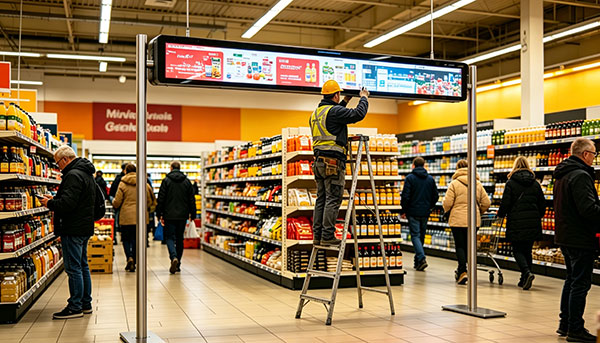
Stretched bar displays — ultra-wide LCD panels with aspect ratios typically ranging from 3:1 to 8:1 — are engineered to integrate directly into retail shelving systems. Unlike conventional signage monitors, they occupy minimal vertical space while delivering maximum horizontal visual impact precisely at the point of purchase. For shelf system manufacturers, this represents both a compelling product differentiation opportunity and a significant technical challenge.
This white paper is written specifically for shelf and fixture manufacturers who are evaluating, sourcing, or actively integrating stretched bar displays into their product lines. It addresses the most critical procurement questions, integration engineering considerations, and total-cost-of-ownership factors that determine project success.
KEY INSIGHT | Retailers who deploy dynamic shelf-edge displays report average sales lift of 15–30% on promoted products and a measurable reduction in staff overhead for promotional updates. Shelf manufacturers who offer integrated display solutions command premium margins and stronger retailer partnerships. |
By the end of this guide, procurement teams and product engineers will understand how to evaluate display specifications that truly matter for shelf integration, which technical pitfalls to avoid, and how to partner effectively with a display manufacturer to bring differentiated shelf products to market.
1. The Market Opportunity: Why Stretched Bar Displays Are Reshaping Retail Shelving
1.1 The Retail Shelf Is Becoming a Digital Platform
Physical retail is not dying — it is evolving. According to industry research, more than 70% of purchase decisions are still made in-store, at or near the shelf. Yet the traditional shelf, equipped with paper price tags and static POS signage, is poorly equipped to deliver the personalization, timeliness, and interactivity that modern shoppers expect.
Stretched bar displays address this gap by transforming a passive surface into an active communication layer. Installed at eye level along the shelf edge, these panels can deliver promotional pricing, product storytelling, nutritional data, inventory information, and real-time content — all within a form factor that does not disrupt the core function of the shelf.
1.2 Why Shelf Manufacturers Are the Critical Enablers
Display suppliers and retailers have attempted standalone deployments of stretched bar panels for years, with mixed results. The fundamental problem is mechanical: a display panel is not a shelf product, and bolt-on mounting solutions create maintenance nightmares, aesthetic inconsistencies, and structural liability issues.
The cleanest, most scalable deployments happen when the display is designed into the shelf system from the beginning — with integrated cable management, standardized mounting interfaces, and purpose-built structural support. This is why leading retailers are increasingly requiring their shelf system suppliers to offer integrated display solutions, rather than sourcing displays separately.
MARKET DRIVER | Tier-1 grocery, pharmacy, and general merchandise retailers are actively qualifying new shelf systems with integrated digital capability. Shelf manufacturers without a credible display offering risk losing preferred supplier status in the 2026–2027 refresh cycle. |
1.3 Competitive Landscape for Shelf Manufacturers
The competitive dynamics are shifting rapidly. Early-mover shelf manufacturers who have successfully integrated stretched bar displays are reporting:
• Contract premiums of 20–40% over comparable non-digital shelf systems
• Higher retailer stickiness due to proprietary content management integrations
• New recurring revenue streams from display maintenance and content services
• Accelerated specification wins in new store construction and remodel projects
Manufacturers who treat display integration as an afterthought — offering displays as optional accessories rather than engineered system components — are finding that retailers prefer competitors with more turnkey solutions.
2. Technology Overview: What Makes a Stretched Bar Display Different
2.1 Panel Architecture and Aspect Ratios
Stretched bar displays are a specialized category of LCD panel, characterized by their ultra-wide aspect ratio. While consumer monitors typically use a 16:9 ratio, stretched bar panels range from 3:1 (e.g., 1280×390) to 8:1 (e.g., 1920×240) or wider. The specific aspect ratio selected must correspond to the physical shelf edge height available in the target shelf system.
Aspect Ratio | Typical Resolution | Panel Height | Best Application |
3:1 | 1280 × 390 | ~39 mm | Open gondola shelving |
4:1 | 1280 × 320 / 1920 × 480 | ~32–48 mm | Mid-shelf price rail |
5:1 | 1920 × 380 | ~38 mm | Pharmacy / specialty retail |
7:1 – 8:1 | 1920 × 240 / 1280 × 160 | ~24–28 mm | Slim-profile premium shelving |
Panel height is the single most constrained dimension in shelf integration. Most retail shelving systems have shelf-edge heights between 25 mm and 55 mm. Display selection must begin with a precise measurement of the available envelope before any other specification is evaluated.
2.2 Brightness and Viewing Environment
Retail environments present significant display challenges that differ fundamentally from standard commercial signage applications. Grocery and pharmacy stores typically operate at ambient light levels of 800–1,200 lux. Supermarkets with freezer aisles can have localized lighting exceeding 2,000 lux directly illuminating shelf-edge panels.
The minimum recommended brightness for shelf-edge applications is 700 cd/m² (nits). For environments with direct overhead illumination or in-case lighting, 1,000 cd/m² is strongly advisable. Undersized brightness specifications are the single most common cause of poor image quality in deployed installations — and the most difficult to remediate without panel replacement.
PROCUREMENT WARNING | Suppliers quoting panels below 700 nits for shelf-edge deployment are either targeting different use cases or are unaware of the ambient conditions in typical retail environments. Require certified brightness test data with every quotation. |
2.3 Thermal Management in Enclosed Shelf Systems
Standard LCD panels are designed to operate in open-air environments. When integrated into enclosed shelf extrusions — especially those made of powder-coated steel or aluminum — thermal conditions change significantly. Panel operating temperature ratings must be verified against the worst-case temperature inside the shelf extrusion under continuous operation.
Key thermal considerations for shelf integration design include:
• Minimum 5 mm clearance between panel rear surface and shelf structure for convective airflow
• Avoid routing power cables directly behind the panel backlight area
• In refrigerated sections, confirm panel minimum storage temperature (typically -20°C) matches transport and installation conditions
• Request MTBF (Mean Time Between Failures) data at both rated temperature and +10°C above rated to model performance degradation
2.4 Interface and Connectivity Standards
Stretched bar displays are available with a range of input interfaces. For shelf integration, the practical choice is almost always between HDMI and proprietary serial interfaces (RS-232 / RS-485). The selection has significant implications for system architecture.
Interface | Advantages | Considerations |
HDMI / Mini-HDMI | Universal compatibility, standard media players, easy content integration | Cable bulk, connector durability in shelf rail, 4K latency overhead |
RS-232 / RS-485 | Daisy-chain topology, low-profile cabling, low power, long runs | Requires proprietary driver, limited content richness, supplier lock-in |
USB-C / DP Alt Mode | Single-cable power+data, modern standard, compact connector | Limited panel availability, verify power delivery spec carefully |
Ethernet / PoE | Network-native, remote management, no dedicated media player | Higher system cost, requires network infrastructure to shelf level |
3. Integration Engineering: Building the Display into the Shelf System
3.1 Mechanical Integration Principles
The mechanical interface between the display panel and the shelf extrusion is where most integration projects encounter their first serious problems. The display manufacturer and the shelf manufacturer are each expert in their own domain; the interface between them requires explicit co-engineering.
Three mechanical integration approaches are in common use:
Approach A — Dedicated Display Rail Extrusion
The shelf system includes a purpose-designed aluminum extrusion profile that accepts the display panel with a front-load snap-fit or tool-free slide-in mounting. This is the highest-quality integration, providing clean aesthetics, reliable retention, and serviceability. It requires close dimensional coordination between display and shelf manufacturer and is recommended for programs above 500 shelf-feet of deployment.
Approach B — Universal Bracket System
An intermediate bracket assembly is designed to adapt the display panel to an existing standard shelf extrusion (e.g., Hettich, Lozier, Madix). This approach enables deployment into existing shelf systems without redesigning the extrusion, but typically adds 4–8 mm to the installed depth and may compromise aesthetics. It is appropriate for retrofit projects and mid-scale deployments.
Approach C — Adhesive or Magnetic Mounting
Tape-based or magnetic mounting is frequently proposed by suppliers as a low-cost option. It should be avoided for all but temporary or pilot installations. Adhesive mounting creates permanent field service challenges, thermal expansion failures, and liability issues if panels detach in public environments.
ENGINEERING RECOMMENDATION | Always request 3D STEP files of the panel assembly (including PCB stack height, connector positions, and cable exit angles) from the display supplier before designing the shelf integration. Panels supplied without dimensional documentation should be disqualified from the shortlist. |
3.2 Cable Management Architecture
Cable management is consistently underestimated in shelf display projects. A single shelf run of 3.6 meters (12 feet) with displays mounted at 600 mm intervals requires 6 panels, each with at minimum a power cable and a signal cable. Multiply by the number of shelf levels (typically 4–6) and the number of fixture runs in a store (100+), and cable management becomes a dominant engineering and installation cost driver.
Best practices for cable management design:
• Route power and signal through an integrated channel in the shelf upright or back panel — never surface-mount cable clips on shelf components visible to the shopper
• Design for a single-cable drop per shelf level where possible, with horizontal distribution via a shelf-integrated bus bar or signal splitter
• Specify connector types that support tool-free field replacement — service calls involving connector repair are disproportionately expensive
• Include strain relief at every cable entry and exit point in the shelf profile
• Provide a color-coded cable labeling specification and require factory pre-labeling on all cable assemblies
3.3 Power Architecture and Load Calculation
Stretched bar displays draw between 5W and 18W per panel depending on size and brightness. For shelf-level power design, the calculation must account for peak load (all panels at maximum brightness displaying white/yellow content), not typical operating load. A conservative multiplier of 1.25× on peak load is appropriate for power supply sizing.
Standard shelf display power configurations:
• 24V DC distributed power with local DC/DC regulation at each panel — most common, cleanest installation
• 48V PoE for network-connected displays — simplifies infrastructure but requires managed switch investment
• 12V DC for low-power slim-profile panels — reduces wire gauge requirements but limits available panel options
Always require that display suppliers provide IEC 62368-1 or UL 60950-1 certification documentation for the power supply assembly, particularly for deployments in the US and EU markets.
3.4 Content Management System Integration
The display hardware is only as valuable as the content system that drives it. Shelf manufacturers increasingly need to provide — or at minimum certify compatibility with — content management platforms that retailers use or plan to use. The most widely deployed platforms in North American and European retail include:
• Pricer ESL and Displaydata for price-tag-adjacent applications
• Samsung MagicINFO and LG SuperSign for HDMI/network-based content
• Scala and Four Winds Interactive for enterprise CMS environments
• Custom retail ERP integrations via REST API for dynamic pricing overlays
When evaluating display suppliers, request a software compatibility matrix that documents tested integrations with major CMS platforms. Suppliers who provide only hardware without any consideration of software compatibility are likely to create costly integration projects downstream.
4. Procurement Evaluation: Choosing the Right Display Manufacturer
4.1 The Eight Criteria That Actually Matter
Shelf manufacturers evaluating display suppliers frequently focus on headline specifications — resolution, brightness, price — while under-weighting the factors that ultimately determine project success. The following eight criteria represent a more complete evaluation framework, ranked by their impact on total program risk.
# | Criterion | What to Evaluate |
1 | Product Longevity Commitment | Written commitment to minimum 5-year production continuity; documented end-of-life notification process (minimum 12 months advance notice) |
2 | Dimensional Stability | Panel-to-panel dimensional variation <0.5 mm; verify with production samples from multiple manufacturing lots |
3 | Customization Capability | Ability to adjust bezel profile, connector position, mounting hole pattern, and cable exit angle without NRE exceeding $15,000 |
4 | Certification Portfolio | CE, FCC, RoHS, REACH, and optionally UL/ETL for North American retail environments |
5 | Minimum Order Flexibility | MOQ ≤500 units for initial program development; path to lower MOQ for spare parts program |
6 | Lead Time Reliability | Published lead times with on-time delivery history (request 12-month OTD data); buffer stock availability |
7 | Technical Support Access | Dedicated FAE (Field Application Engineer) assignment; response SLA of <4 hours for production issues |
8 | Warranty and RMA Process | Minimum 2-year warranty; advance replacement available; documented failure rate data by model |
4.2 Red Flags in Supplier Evaluation
The following supplier behaviors are reliable indicators of downstream project risk. Any one of these should trigger deeper due diligence; multiple occurrences should lead to disqualification.
• Unable or unwilling to provide production samples within 4 weeks of inquiry
• Brightness or resolution specifications not backed by independent test reports
• No written product longevity commitment — verbal assurances are insufficient
• Quotations that specify a single-source panel from a tier-3 panel manufacturer with no backup
• Lack of familiarity with CE/FCC certification requirements for the target market
• CMS compatibility claims not supported by integration documentation or reference customers
• No prior experience with shelf or fixture integration (only standalone signage deployments)
DUE DILIGENCE TIP | Request the names of two shelf manufacturer reference customers who have deployed the proposed panel model in production volumes. A supplier with genuine shelf integration experience will be able to provide these without hesitation. |
4.3 Total Cost of Ownership Analysis
Panel unit cost is rarely the largest element of total program cost. A realistic TCO analysis for a shelf display program spanning 50 retail locations over 5 years must account for the following cost categories:
Cost Category | % of 5-Year TCO (Typical) | Key Driver |
Panel hardware (initial) | 28–35% | Unit price × total installed count |
System integration engineering | 12–18% | Complexity of shelf-display interface design |
Installation labor | 18–25% | Cable management complexity and tool requirements |
Content management system | 8–14% | CMS licensing and custom development |
Field service and replacement panels | 10–16% | Panel MTBF, connector reliability, service accessibility |
Spare parts program | 4–8% | Supplier MOQ for spares, shelf life of panels |
This analysis consistently shows that reducing installation labor and field service costs through better mechanical design yields a higher ROI than negotiating marginal savings on panel unit price. A panel that costs 10% more but reduces installation time by 30% and field service calls by 50% will be significantly cheaper over a 5-year program lifecycle.
5. Technical Specification Reference
5.1 Minimum Recommended Specifications for Retail Shelf Deployment
The following specifications represent minimum thresholds for production deployment in standard retail environments. Programs with specific environmental challenges (freezer aisles, outdoor-facing windows, food service) should consult with the display manufacturer for environment-specific guidance.
Parameter | Minimum Specification for Retail Shelf Deployment |
Panel Brightness | 700 cd/m² (1,000 cd/m² recommended for high-ambient environments) |
Contrast Ratio | 800:1 minimum (1,200:1 preferred) |
Color Gamut | 72% NTSC (sRGB equivalent) minimum |
Viewing Angle | 160° horizontal / 120° vertical (H/V) |
Operating Temperature | 0°C to +50°C; storage -20°C to +60°C |
Operating Humidity | 10% to 85% RH non-condensing |
Panel Life (MTBF) | ≥ 30,000 hours at rated brightness |
Backlight Type | LED only (CCFL panels are not acceptable) |
Input Interface | HDMI 1.4 or higher; RS-232 for serial-controlled deployments |
Power Input | DC 12V or 24V ±10%; ripple <200 mV |
Power Consumption | < 15W per panel (30" class); < 8W per panel (under 18") |
Bezel Tolerance | ±0.3 mm on height-critical dimensions |
Certifications | CE + RoHS for EU; FCC Class B + UL/ETL for North America |
Warranty | 24 months minimum from date of shipment |
5.2 Standard Panel Size Reference
The following panel sizes represent the most commonly deployed formats in retail shelf environments globally. Availability varies by supplier; confirm production status before designing to a specific size.
Diagonal Size | Resolution | Active Width | Active Height | Typical Application |
8.8" | 1920 × 480 | 218 mm | 56 mm | Standard gondola shelving |
11.9" | 1920 × 480 | 295 mm | 74 mm | Supermarket aisle end-cap |
14.9" | 1920 × 360 | 369 mm | 70 mm | Pharmacy / HBC shelving |
19.3" | 1920 × 360 | 478 mm | 90 mm | Wide-shelf general merchandise |
23.1" | 1920 × 360 | 573 mm | 108 mm | Refrigerated case shelf front |
28.6" | 2560 × 360 | 710 mm | 100 mm | Premium / flagship store shelving |
6. Implementation Roadmap for Shelf Manufacturers
6.1 Program Development Phases
Successful shelf display integration programs follow a structured development process. Shelf manufacturers who attempt to compress or skip phases consistently encounter costly redesigns and deployment delays. The following timeline assumes a standard program with a new retail customer.
Phase | Duration | Key Activities & Milestones |
1 — Discovery | 2–4 weeks | Shelf dimension survey; retailer requirement brief; CMS platform identification; display supplier RFQ release |
2 — Concept Design | 4–6 weeks | Panel selection and 3D STEP integration; cable routing concept; power architecture schematic; supplier evaluation and down-select |
3 — Prototype | 6–10 weeks | First article panels from supplier; prototype shelf extrusion with display; cable management mockup; thermal test at rated conditions |
4 — Pilot | 8–12 weeks | 25–50 shelf units installed in 1–2 live retail locations; content management integration test; staff training validation; snag list resolution |
5 — Production Ramp | Ongoing | Full production tooling; supplier volume scheduling; spare parts program establishment; field service documentation |
6.2 Managing the Supplier Relationship
The relationship between a shelf manufacturer and a display supplier is fundamentally different from a standard component procurement relationship. Display suppliers must function as engineering partners, not just vendors. Setting up the relationship correctly from the beginning prevents the most common and costly failure modes.
Recommended structural elements of a display supplier partnership:
• Joint product development agreement with IP ownership terms explicitly defined
• Quarterly business reviews covering delivery performance, quality data, and roadmap alignment
• Assigned FAE with direct access during prototype and pilot phases
• Written EOL notification obligation of not less than 12 months
• Buffer stock agreement — supplier maintains 4–8 weeks of inventory for the program
• Agreed failure rate targets with remediation triggers and financial consequences
6.3 Field Service and Maintenance Design
Display panels will fail in the field. The rate and pattern of failures is predictable and must be planned for in the shelf system design. Panels that require tool access or shelf section removal for replacement will generate disproportionate service costs and retailer dissatisfaction.
Design for serviceability principles:
• Front-access panel removal — the failed panel should be replaceable from the shopper aisle side without moving product or dismounting the shelf
• Snap-fit or quarter-turn connector retention — avoid fastener-based panel retention in high-service programs
• Unique panel orientation keying — prevents incorrect reinstallation in the field
• LED indicator for power-on status visible from front without panel removal for rapid fault isolation
SERVICE COST BENCHMARK | Field service calls to replace a display panel range from $85 to $250 per event depending on store location and labor agreement. A shelf design that reduces mean replacement time from 25 minutes to 8 minutes reduces per-event cost by approximately 55% — far exceeding the cost of any mechanical design optimization. |
7. Conclusion: Building a Sustainable Digital Shelf Capability
Stretched bar displays represent a generational opportunity for shelf system manufacturers. The retailers who will dominate the next decade of physical commerce are investing heavily in making every shelf an active communication and commerce platform. The shelf manufacturers who earn their business will be those who can deliver integrated display solutions that are engineered to last, easy to service, and genuinely differentiated from what a retailer could assemble independently.
The path to that capability is not simple. It requires technical depth in display engineering, mechanical design discipline, supply chain partnerships that go beyond transactional procurement, and a commitment to field service quality that spans years. But the competitive moat it creates — once established — is substantial and durable.
The key principles to carry forward from this guide:
• Start with the shelf envelope — display selection must follow dimensional constraints, not precede them
• Specify brightness correctly — 700 nits minimum; 1,000 nits for most grocery environments
• Design mechanical integration as a co-engineering project with the display supplier
• Build cable management into the shelf architecture, not around it
• Evaluate suppliers on longevity commitment, support quality, and integration experience — not on unit price alone
• Plan the field service model before the first unit ships, not after the first failure
Manufacturers who approach digital shelf integration with the same engineering rigor they apply to their structural shelf systems will build programs that succeed at scale — and customers who recognize that quality will remain loyal partners for program lifetimes measured in years, not purchase orders.
Ready to Start Your Shelf Display Program?
Contact our shelf integration engineering team to discuss your specific program requirements,
request production samples, or arrange a technical consultation.
www.hitulcd.com | chenhua@hitulcd.com